An FRP embed angle, also called an embedment angle, is a pultruded fiberglass profile cast into the edge of a concrete trench, pit or curb to provide a flat, corrosion-proof seat for fiberglass grating products. It replaces steel angle iron in the same spot, so the grating stops rattling and the concrete edge stops chipping, without introducing a rust point into an otherwise corrosion-resistant system.
Key takeaways:
An FRP embed angle is a pultruded fiberglass profile cast into concrete to seat and anchor grating over trenches, pits and curbs.
Standard sizes run from 1″ x 1-1/2″ to 2″ x 1-1/2″, typically 1/4″ thick, in 20-foot stock lengths.
Vinylester resin embed angles carry a Class 1 fire rating, an ASTM E-84 flame spread of 25 or less, and UL 94VO self-extinguishing classification.
Ribbed or “Y-leg” profiles anchor into concrete without extra fasteners; smooth “L” profiles need supplemental clips.
DEFI Fiberglass fabricates embed angles and matching pultruded grating from its Houston and Youngsville, LA plants for Gulf Coast delivery.
What Is an FRP Embed Angle?
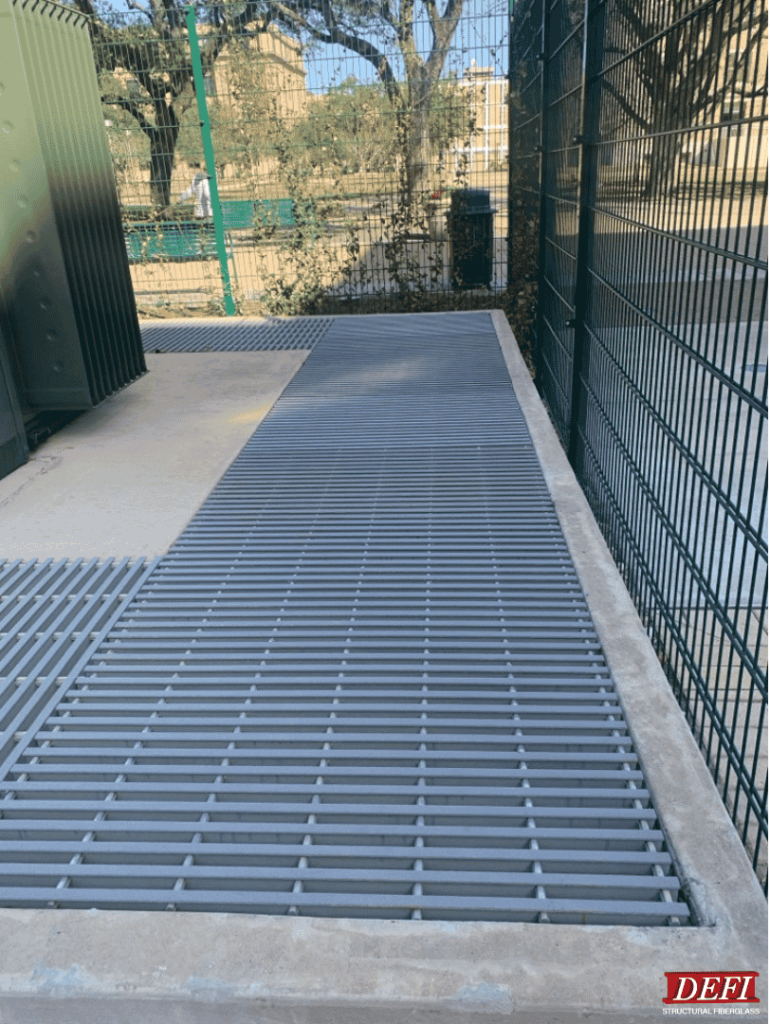
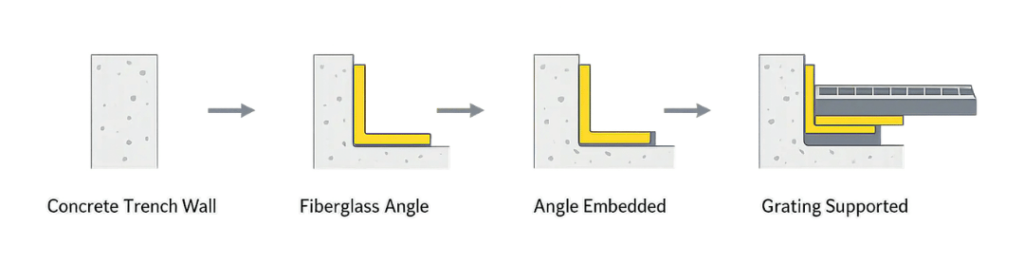
An FRP embed angle is an L-shaped (or ribbed, near-L-shaped) pultruded fiberglass profile that sits at the top edge of a concrete trench or pit wall. Half of it gets poured into the concrete; the other leg projects inward to form a ledge that carries the grating’s weight and keeps it from shifting side to side.
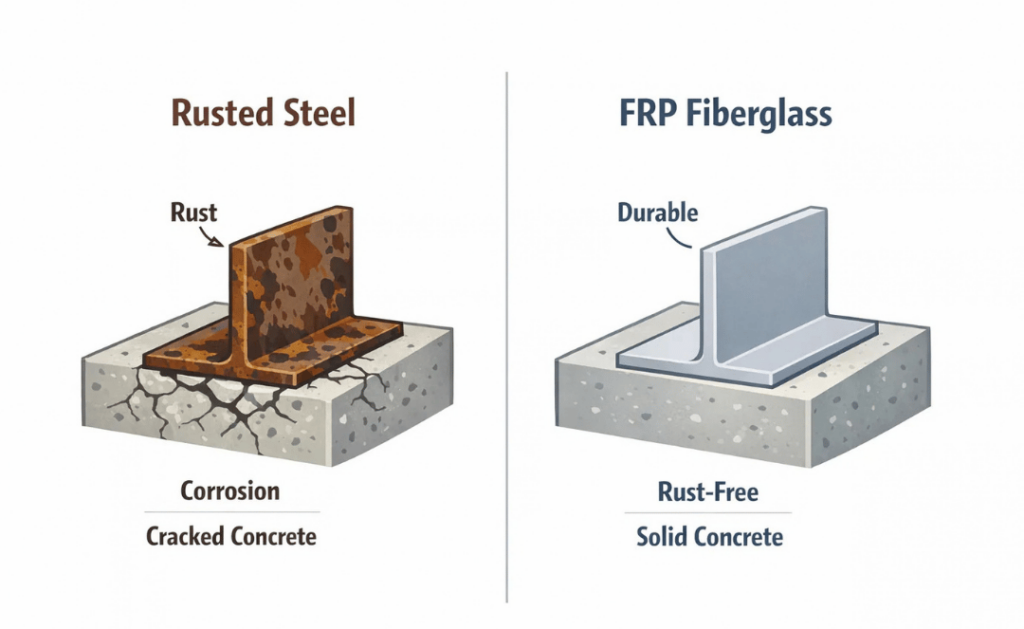
Bare concrete edges chip and shift under foot or forklift traffic. The embedment angle fixes that: it’s straight, dimensionally consistent, and made of the same corrosion-resistant material as the grating above it, so there’s no dissimilar metal at the waterline to rust.
Every manufacturer’s embedment angle does the same job with small design and resin differences.
How It Sits in the Concrete Pour
The angle is set into trench formwork before the pour, nailed or braced to a wooden nailer so it stays level while concrete is placed around its anchoring leg. Once the concrete cures and forms come out, the exposed leg stays as a permanent ledge sized to the grating’s depth.
A bed angle frame calls for a minimum thickness of 1/4″ and anchor studs within 6″ of each end, spaced no more than 24″ apart, worth checking against your own engineer’s spec, since it’s written for steel frames rather than FRP-specific systems.
Standard Sizes and Weights
Most suppliers stock the same handful of sizes because they match common grating depths (1″, 1-1/2″ and 2″).
Sizing follows the grating depth you’re anchoring, not the trench span: a 1-1/2″ deep grating panel needs an angle with a matching leg, or the surface won’t sit flush. Thicker isn’t automatically better, going up a gauge adds weight and cost without adding useful anchorage once the leg is keyed into the concrete. Most FRP embedment angles ship in gray or dark-gray vinylester resin as standard.
FRP Embed Angles vs. Steel Embed Angles
The choice comes down to the waterline: steel embed frames are cheaper and widely stocked, but corrode where concrete meets moisture, chemicals or de-icing salts, exactly where an embed angle sits.
Factor | FRP embedment angle | Steel embed angle |
|---|---|---|
Corrosion in wet/chemical service | Resists indefinitely | Rusts, needs coating or galvanizing |
Conductivity | Non-conductive | Conductive |
Weight | Lighter, easier to handle on site | Heavier |
Upfront cost | Higher per foot | Lower per foot |
Fire performance (vinylester resin) | Class 1, self-extinguishing per UL 94VO, | Non-combustible by nature |
Sizing reference | size charts | Sized frame specs |
In a water treatment trench or chemical pit, matching the embedment angle’s material to the grating is the standard spec; a steel angle under FRP grating reintroduces the corrosion problem the grating was meant to solve.
Installation Notes
Set the angle before the pour, not after: retrofitting one into cured concrete means drilling and epoxy-anchoring it instead of letting the concrete lock around a continuous anchoring leg, a weaker connection.
Keep it level and square in the formwork, a twisted angle throws off every panel that sits on it, and confirm leg depth against actual grating thickness before the pour if the grating and angle come from different suppliers. See DEFI’s rundown of FRP installation mistakes for more on avoiding costly rework.
Where DEFI Fiberglass Fits In
DEFI Fiberglass fabricates pultruded structural shapes and pultruded grating from its Houston and Youngsville, Louisiana plants, and can spec embedment angles alongside a grating order so hardware and panels match in resin, gray color and depth from day one. Custom leg sizes and anchoring details route through DEFI’s Louisiana Structural Fiberglass fabrication division, contact DEFI with your grating depth and span for sizing and lead time. Structural FRP shapes and grating are covered in more depth on DEFI’s structural FRP overview.
Frequently Asked Questions
What is an FRP embed angle used for?
It’s cast into a concrete trench, pit or curb wall to give fiberglass grating a level, corrosion-resistant seat, replacing a bare concrete lip or a steel angle that would rust in the same spot, per the product design shown.
What sizes do FRP embed angles come in?
Common stock sizes run from 1″ x 1-1/2″ to 2″ x 1-1/2″, generally 1/4″ thick and sold in 20-foot lengths, matching standard 1″, 1-1/2″ and 2″ grating depths.
Can FRP embed angles be used in corrosive environments?
Yes, that’s their main advantage over steel. Vinylester-resin FRP angles resist chemical attack and won’t rust at the concrete-moisture interface where steel embeds typically fail first.
Do FRP embed angles need extra anchors?
Ribbed or “Y-leg” profiles are designed to key into the concrete pour on their own. Flat “L” profile angles may need supplemental clips or anchors, so check the manufacturer’s spec before the pour.
Does thicker always mean better for FRP embed angles?
No. Once the angle’s leg is properly keyed into the concrete and sized to the grating depth, added thickness mainly adds weight and cost rather than additional holding strength.
How is an FRP embed angle installed?
It’s set into the trench formwork before the concrete pour, braced level and square (often nailed to a wooden nailer), then left in place as a permanent ledge once the concrete cures and the forms are stripped.
Are FRP embed angles fire-rated?
Vinylester-resin embed angles from manufacturers like Structural Fiberglass Inc. carry a Class 1 fire retardance rating, an ASTM E-84 flame spread of 25 or less, and are classified self-extinguishing per UL 94VO.
Check out our resources page here.
Follow us on LinkedIn!