

DEFI is a catwalk manufacturer that designs, fabricates and ships complete fiberglass-reinforced polymer (FRP) catwalk and platform systems: grated decking, stairs, handrails, toe boards and fasteners, kitted and ready to assemble on your site.
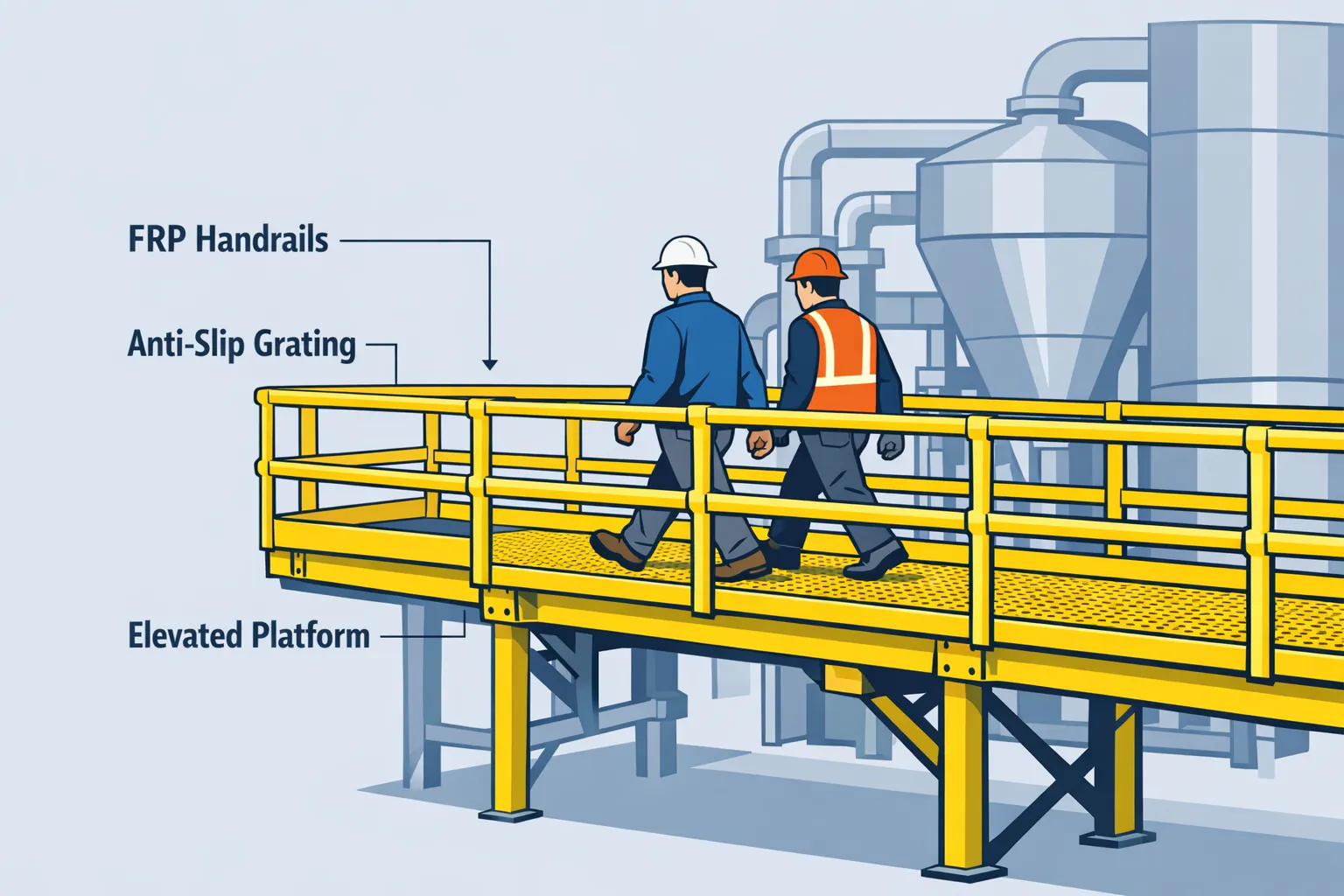
Unlike steel or aluminum catwalks, DEFI’s FRP catwalk systems give you steel-level strength without the corrosion, weight, or ongoing maintenance, and they’re built to meet OSHA’s walking-working surface rules out of the box. Every project is engineered around your facility’s layout and access needs, with a custom design for each site.
Key takeaways
DEFI catwalk kits include grating, stairs, handrails, toe boards and fasteners as one pre-engineered, ready-to-assemble system.
FRP catwalks are lightweight, non-conductive and corrosion-proof, and can last 20+ years with little to no maintenance when installed correctly.
OSHA requires catwalks to be at least 18 inches wide, guarded by a 42″ (±3″) rail system on open sides over 4 feet high, per 1910.28 and 1910.29.
DEFI builds to the same strength and safety specs as steel, with flame-retardant resin, anti-slip surfacing and safety-yellow coloring standard.
FRP vs. Steel vs. Aluminum Catwalks
A catwalk manufacturer’s choice of material drives nearly every downstream cost: installation labor, maintenance budget, and service life. Facilities across the United States are retiring corroded steel industrial catwalks in favor of FRP for exactly these reasons.
Factor | FRP (DEFI) | Steel | Aluminum |
|---|---|---|---|
Corrosion resistance | Will not rust or corrode | Corrodes in moisture/chemicals | Resists rust, but can corrode in caustic/chemical environments |
Weight | Lightweight; installs with hand tools | Heavy; needs cranes/heavy equipment | Lighter than steel, heavier than FRP |
Electrical conductivity | Non-conductive | Conductive | Conductive |
Typical maintenance | Minimal; no painting or coating | Regular inspection, painting, rust treatment | Low, but galvanic corrosion risk near dissimilar metals |
Expected service life | 20+ years in corrosive settings | Shorter in corrosive/coastal environments without upkeep | Long, but strength-to-weight drops under heat |
That combination of corrosion resistance and a high strength-to-weight ratio is why FRP has become the default upgrade path for plants retiring old steel catwalks. Other catwalk manufacturers, including ErectaStep, Panel Built and Abtech, focus on modular aluminum or steel access systems for general industrial use; DEFI focuses specifically on FRP for the corrosive, electrically hazardous facilities those metals struggle to hold up in.
What’s Included in a DEFI Catwalk System
Every DEFI catwalk system is engineered as one complete, custom design for your project, not a pile of parts you have to specify separately:
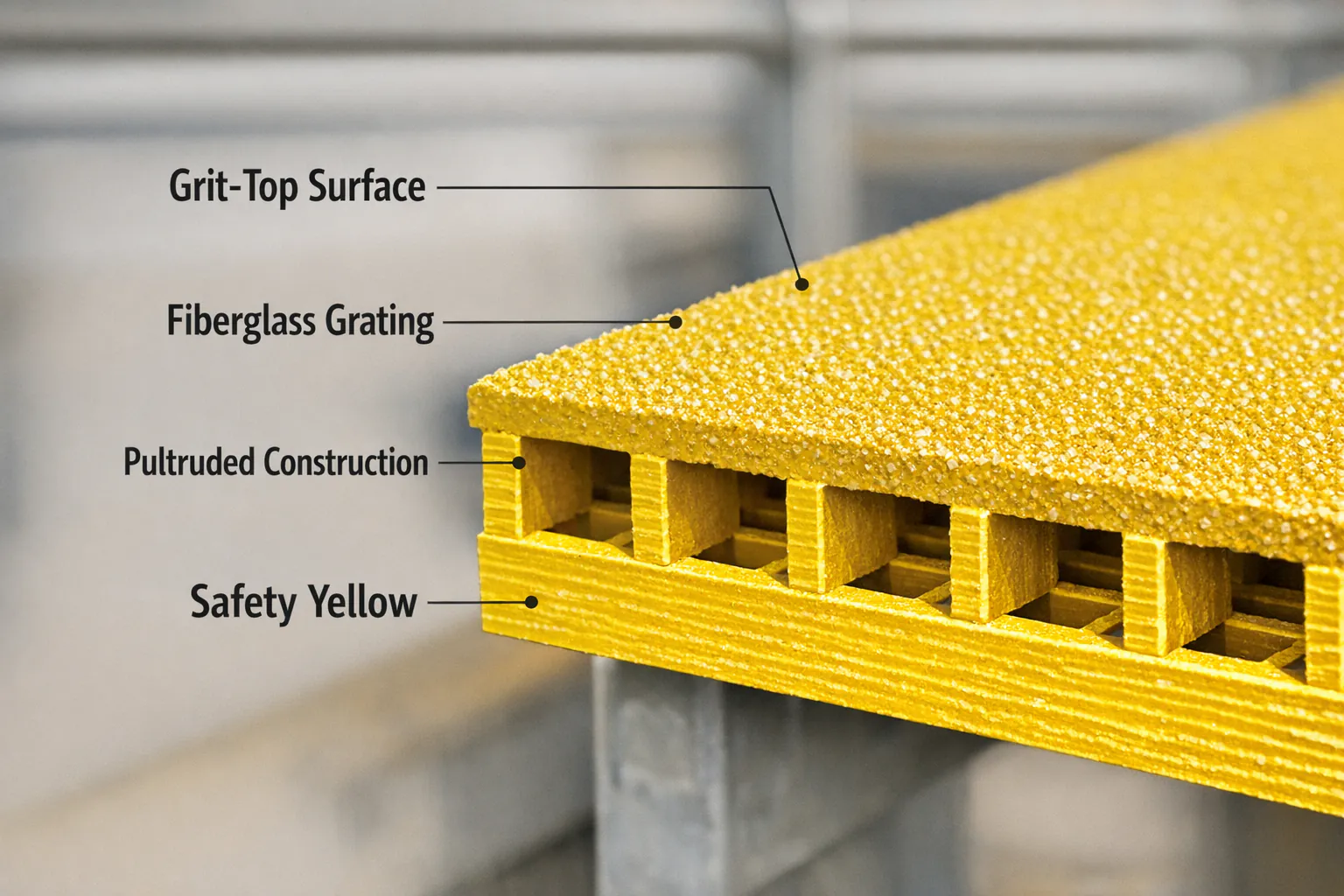
FRP grated decking, pultruded or molded grating with a grit-top, anti-slip surface as standard.
Stairs and ladder access sized to your elevation change, access path and OSHA stair geometry.
Handrails and guardrails rated to the loads your application requires.
Toe boards and fasteners, including 316 stainless steel hardware where corrosion resistance matters most.
Pre-drilled, cut-to-size components, shipped ready to assemble (RTA) with standard hand tools, no welding or heavy machinery required.
Because the kit ships pre-engineered, you can bolt a DEFI catwalk together on site without the foundation work or specialty equipment steel structures usually demand. For connecting runs between platforms, see our crossovers; for fixed vertical access up to the catwalk, pair it with our ladder and cage systems.
Built to Meet OSHA Catwalk Standards
OSHA regulates catwalks under 29 CFR 1910 Subpart D, Walking-Working Surfaces, and DEFI systems are designed and manufactured to meet or exceed those requirements.
The baseline numbers every facility manager should know, per OSHA’s own walkway rules and the full 1910.28 regulation text:
Minimum width: 18 inches for a standard catwalk or runway (1910.28(b)(5)(ii)(A)); wider if a stairway or IBC stair feeds into it.
Fall protection: required wherever an open side is 4 feet or more above a lower level, typically a guardrail system (1910.28(b)(5)(i)).
Guardrail height: top rail at 42 inches, plus or minus 3 inches, able to withstand 200 lbf of downward or outward force without failing (1910.29(b)).
Stair geometry: maximum 9.5-inch riser height and 9.5-inch minimum tread depth for stairs accessing the catwalk.
OSHA’s enforcement history underlines why this matters: the agency has documented incidents where a corroded steel catwalk gave way and a worker fell, which is the exact failure mode FRP avoids because it does not rust. The industry is responding by specifying lighter, corrosion-proof materials for new builds. TJ Looper, Regional Sales Manager at Fibergrate, told the company’s blog that “we’re starting to see FRP catwalk grating used in data center designs because of the benefits in lightweight installations. There’s a benefit to having a material that can be handled safely by two people instead of requiring a crane.” DEFI builds to the same logic: every kit is sized so your crew can install it without renting heavy lifting equipment.
Engineered for Decades of Service
Catwalks and elevated walkways see constant foot traffic, and replacing one mid-life is disruptive and expensive. DEFI catwalks and platforms are virtually maintenance-free and, installed properly, can last upwards of 20 years in environments that would eat through steel in a fraction of that time.
That durability comes from the resin system, not a coating. Because the corrosion resistance is built into the material itself, there’s no paint to chip, no galvanizing to wear through, and no recurring inspection-and-recoat cycle. For a deeper look at how FRP’s strength compares with steel, see is fiberglass stronger than steel.
Safety by Design
A catwalk is only as good as its safety features, and a safe design keeps workers protected on every shift. DEFI builds safety into every catwalk system rather than bolting it on after the fact, and outlines why guardrails and toe boards are standard on any walkway built to code:
Flame-retardant resins that self-extinguish when the flame source is removed.
Anti-slip grit-top surfacing that keeps traction even with oil, grease or water underfoot.
Safety-yellow coloring as standard, for visibility in low-light industrial settings.
Non-conductive construction, removing electrical shock risk around live equipment, the same property behind our non-conductive FRP line.
These features, combined with the OSHA-spec guardrails and toe boards built into every system, are why DEFI catwalks are designed and manufactured to meet or exceed strict OSHA guidelines rather than requiring retrofits later.
DEFI has spent decades fabricating FRP structures for the Gulf Coast’s harshest facilities, and that experience backs every catwalk system design we ship. Ready to replace a corroding steel catwalk or spec a new one for your project? Request a quote and our team will design a custom, OSHA-compliant catwalk system built for your facility, your access needs and your timeline.
FAQ
Who manufactures FRP catwalks?
DEFI Fiberglass manufactures complete FRP catwalk and platform systems, fabricating grating, stairs, handrails and hardware as one kit from its Houston and Lafayette, Louisiana plants, through its Louisiana Structural Fiberglass fabrication division.
What is the OSHA minimum width for a catwalk?
A standard catwalk or runway must be at least 18 inches wide under OSHA 1910.28(b)(5)(ii)(A). If a stairway serves it, the catwalk must be at least as wide as that stairway, which has its own 22-inch minimum.
Are FRP catwalks better than aluminum catwalks?
For corrosive or electrically hazardous environments, yes. FRP is non-conductive and immune to the galvanic and chemical corrosion that can affect aluminum, while matching aluminum’s lightweight, easy-install advantage over steel.
How long do fiberglass catwalks last?
Installed correctly, DEFI’s FRP catwalks and platforms can last upwards of 20 years with minimal maintenance, since the corrosion resistance is built into the resin and fiberglass itself rather than applied as a coating.
Can catwalks be custom sized?
Yes. DEFI catwalk and platform kits are built to your layout, elevation change, and load requirements, including custom stair runs, handrail configurations and anti-slip grating options.
Is fiberglass grating slippery when wet?
No. DEFI’s grating uses a grit-top anti-slip surface as standard, designed to retain grip even when exposed to oil, grease or water, which is one of the OSHA-aligned safety features built into every catwalk kit.
Do FRP catwalks need special tools to install?
No. DEFI components are pre-drilled and pre-cut, shipped ready to assemble with standard hand tools, so crews can install a full catwalk system without cranes, welding equipment or foundation reinforcement.


