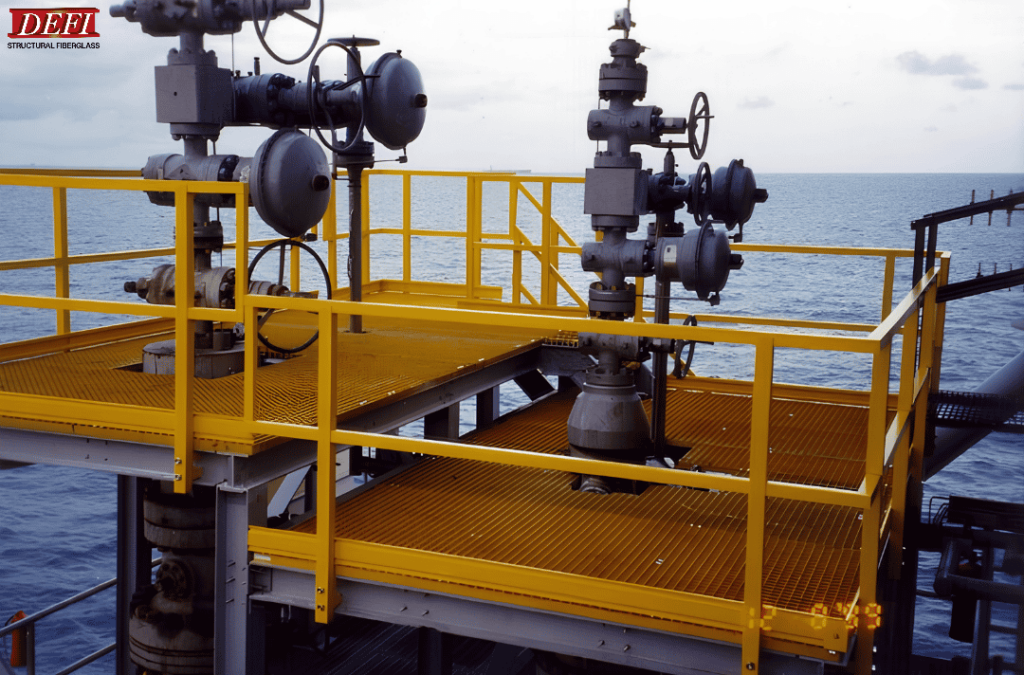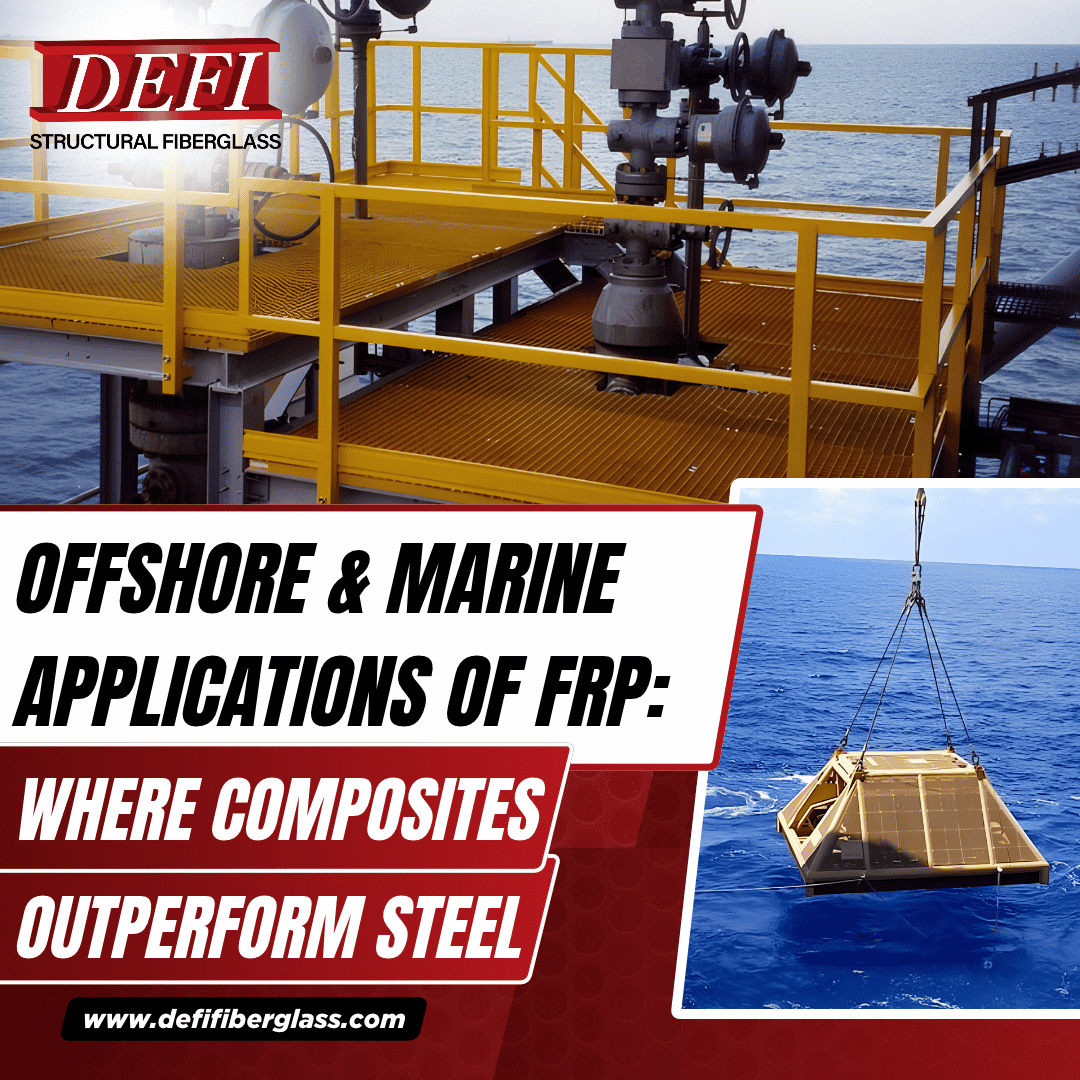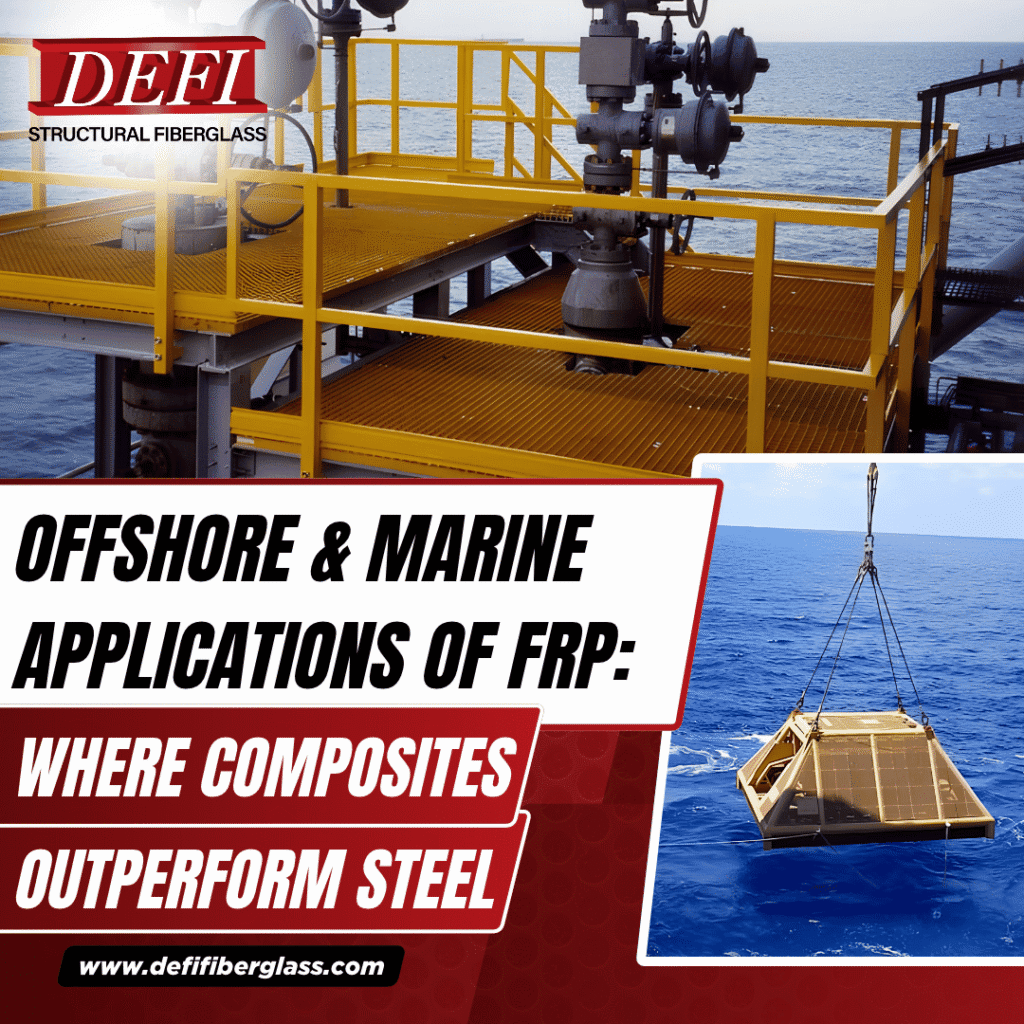
Fiber-reinforced polymer (FRP) is used offshore and in marine settings for platforms, walkways, handrails, cable management, subsea support structures and floating docks, anywhere saltwater, humidity and constant vibration wear steel down fast.
It doesn’t rust, it’s non-conductive, and it weighs a fraction of what comparable steel structures weigh, which matters enormously once a component has to be lifted onto a platform or flown out to a rig.
That combination is why oil and gas operators, offshore wind developers and marine facilities have been replacing steel with composites in splash zones and subsea systems for decades. These offshore and marine applications of FRP keep expanding as more operators move away from coated steel.
Key takeaways:
FRP resists saltwater corrosion in environments where coated steel fails within a few years.
FRP structural shapes can weigh up to roughly 75% less than steel, cutting transport, lifting and installation costs offshore.
Common offshore and marine uses include personnel platforms, walkways, handrails, cable trays, ladder cages, subsea support structures and floating docks.
FRP is non-conductive and non-magnetic, which matters around electrical gear, navigation equipment and instrumentation.
Corrosion already costs the U.S. an estimated $276 billion a year, about 3.1% of GDP, and offshore maintenance access makes that bill worse, not better.
Why the Marine Environment Destroys Steel So Fast
Saltwater, UV exposure, humidity and constant mechanical loading combine to attack metal continuously, not occasionally, which is what separates marine duty from most onshore industrial settings.
Salt spray penetrates coatings and accelerates electrochemical corrosion on steel, while the same coatings degrade under UV, constant water exposure and mechanical wear. Every touch-up requires sending crews, scaffolding or vessels out to a structure that may only be reachable in good weather. A TNO study on offshore wind operations puts offshore operation and maintenance costs at roughly ten times onshore costs, simply because of accessibility.
FRP sidesteps the problem at the material level instead of trying to protect a metal substrate. Glass fiber and resin don’t rust, so there’s no coating to maintain, inspect or replace on a weather-dependent schedule. DEFI Fiberglass builds its offshore FRP line around exactly this: low maintenance, low smoke and toxic fume output, and resistance to the high temperatures and fire conditions found on platforms.
FRP vs. Steel in Offshore Conditions
The two materials trade off strength for weight and maintenance, and the comparison looks significantly different once you factor in a 20-year service life rather than a purchase order, as the table below shows.
Factor | FRP | Steel |
|---|---|---|
Corrosion in saltwater | Resistant; no rust mechanism | Corrodes once coatings fail |
Weight | Up to ~75% lighter than steel | Heavy; drives lifting/crane needs |
Conductivity | Non-conductive | Conductive; galvanic corrosion risk |
Magnetic properties | Non-magnetic | Magnetic; can interfere with sensitive instruments |
Tensile strength | ~30,000 PSI, per DEFI’s structural profile guide | ~60,000 PSI (A-36) |
Maintenance | Minimal; no repainting cycle | Recurring inspection, coating, replacement |
Service life in splash zones | Decades without coating renewal | Often compromised within years |
Steel still wins on raw tensile strength, which is why engineers size FRP members generously rather than swap steel sections one-for-one. Where FRP wins is total cost of ownership: fewer helicopter or vessel trips for maintenance, less downtime, and a structure that still looks and performs the same after a decade in the splash zone.
Naval and Shipbuilding Roots of Modern Marine Composites
Offshore platforms didn’t invent the use of composite material at sea. Glass fiber reinforced polymer (GFRP), sometimes called Glass FRP, powered naval hulls back in the Cold War era. That history still shapes how engineers design FRP for offshore duty today.
The first application of glass-reinforced plastic for naval shipbuilding dates back to 1973 with the mine-countermeasures vessel HMS Wilton, which “proved to be able to withstand the extreme working conditions in the Ocean as well as impacts and fires,” according to a 2020 review in the Journal of Marine Science and Engineering.
Ship designers at the Massachusetts Institute of Technology still study FRP for the same reasons offshore engineers choose it now. It cuts weight. It stays non-magnetic. It resists constant water exposure. Some naval hulls add Kevlar or carbon fiber reinforced polymer (CFRP) where stiffness per pound matters most, such as radar housings. Offshore oil, gas and wind structures mostly stick with glass-based reinforced plastic instead, because it delivers comparable corrosion performance at a lower material cost.
The lesson carries over directly. A composite material that survives an ocean crossing needs saltwater resistance, non-magnetic behavior and a strong strength-to-weight ratio. Marine structures on an offshore platform need the exact same properties. Construction methods have moved on, from hand-laid naval hulls to pultruded structural profiles and molded grating, but the underlying engineering case for FRP as a product category hasn’t changed.
Where FRP Shows Up Offshore and in Marine Settings
FRP has moved from a niche substitute to the default choice for specific zones on platforms, vessels and marine infrastructure.
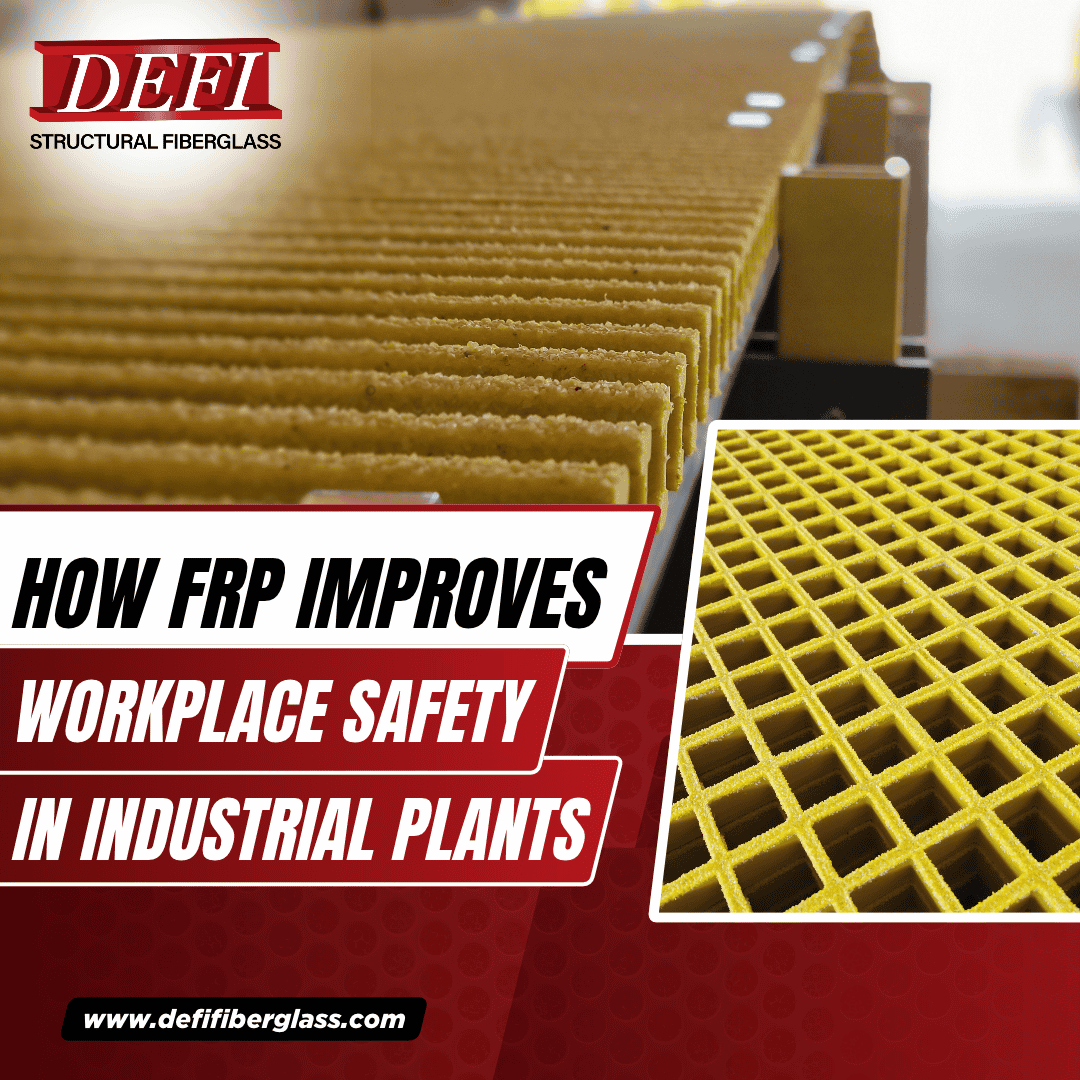
Personnel platforms and walkways, phenolic and polyester FRP grating forms non-skid walking surfaces that stay sure-footed even when wet or oily.
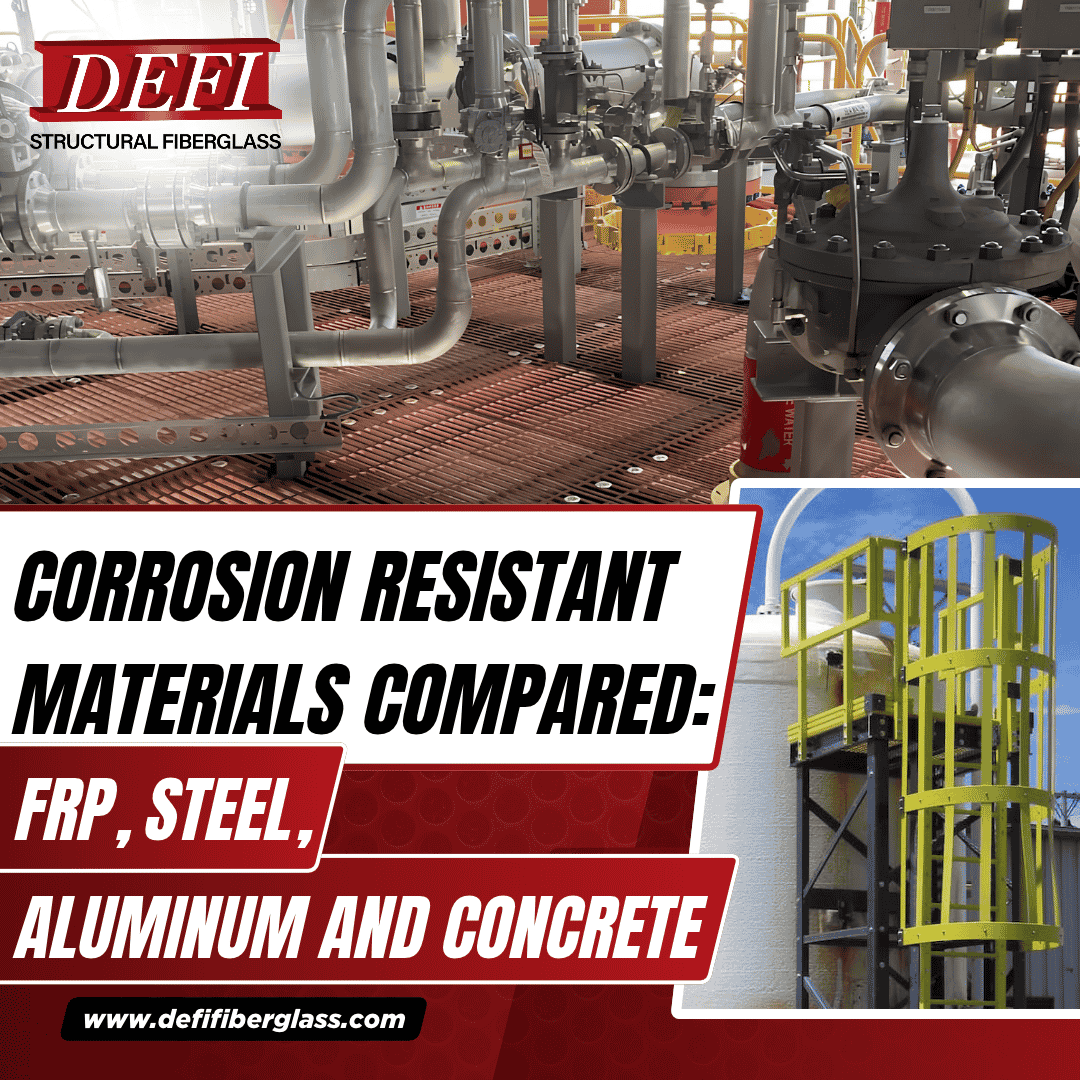
Handrails and ladder cages, non-conductive, corrosion-proof fall protection around wellheads, tanks and access points.
Cable management, FRP cable trays and ladder systems hold up to moisture and salt where steel trays corrode and sag.
Subsea and splash-zone support, structures that sit at or below the waterline, including BOP walkways, ROV moon pool platforms and drop protection for manifolds, where DEFI’s subsea line is built to run at roughly a third the weight of steel.
Floating docks and pontoons, mining dewatering pumps and water-treatment platforms, where buoyancy and corrosion resistance both matter.
Aquaculture and coastal infrastructure, rafts, frames and walkways that sit in continuous seawater contact, an application Nanjing Spare Composites notes has already replaced wood and metal structures in some oyster farming operations.
Subsea and Splash-Zone Specifics
The splash zone, where a structure is alternately wet, dry, and battered by wave action, is the single hardest service condition in offshore engineering, and it’s where FRP’s advantage is largest.
Steel in this zone needs cathodic protection, sacrificial anodes and recurring coating work, because the wet-dry cycle accelerates corrosion faster than constant submersion or constant air exposure alone. FRP structures don’t need any of that upkeep. DEFI’s fabrication division, Louisiana Structural Fiberglass, handles project-specific items for this zone, including pipe penetrations and cathodic protection components built around FRP rather than relying on it to protect steel.
Below the splash zone, FRP’s electrical and magnetic neutrality becomes the deciding factor. Subsea instrumentation, ROV equipment and navigation systems can be sensitive to magnetic interference, something a steel structure introduces and an FRP one doesn’t.
Choosing the Right FRP for a Marine or Offshore Project
Not every FRP formulation suits every marine application, and picking the wrong resin system undercuts the whole value case.
Vinyl ester resin handles strong acids, chlorine exposure and high-temperature chemical contact, which suits process areas on oil and gas platforms. Polyester resin, less expensive, still resists saltwater, brine and most petroleum products, and works well for grating, handrails and walkways that face weather rather than process chemicals. Engineers also need to account for UV exposure, expected service life, fire performance and the specific mechanical loads a structure will carry, since standard profiles don’t always meet span or load requirements on a custom platform.
DEFI Fiberglass fabricates both standard and project-specific FRP structures from its Houston and Lafayette plants, drawing on structural profiles sized for the offshore loads engineers actually spec, not catalog defaults. For a deeper look at how FRP terminology breaks down, see our guide on the difference between FRP and GRP.
FAQ
Why is FRP used offshore instead of steel?
FRP resists saltwater corrosion without coatings, weighs up to roughly 75% less than steel, and is non-conductive and non-magnetic, all of which cut maintenance trips and installation costs on platforms where access is expensive.
Is FRP strong enough for offshore structural applications?
Yes, for the applications it’s engineered for. FRP structural profiles deliver around 30,000 PSI tensile strength versus roughly 60,000 PSI for A-36 steel, per DEFI’s structural profile guide, so engineers size members larger rather than substituting steel sections directly, which still produces a lighter, corrosion-free structure overall.
Can FRP be used below the waterline?
Yes. Subsea applications include BOP walkways, ROV moon pool platforms and drop protection for manifolds, where FRP’s corrosion resistance and roughly one-third the weight of steel simplify both fabrication and installation.
Does FRP need cathodic protection like steel does?
No. FRP doesn’t corrode electrochemically, so it doesn’t need sacrificial anodes or cathodic protection systems the way steel does in splash-zone and subsea service. Fabricators can still integrate cathodic protection components into an FRP structure where it interfaces with steel equipment.
How does FRP handle offshore wind applications?
Offshore wind turbines and substations face the same saltwater and accessibility challenges as oil and gas platforms, and FRP’s low maintenance profile is especially valuable there given that offshore operations and maintenance can run roughly ten times the cost of onshore work.
What’s the lifespan of FRP in marine environments versus steel?
FRP structures routinely run for decades in marine and splash-zone service without the repainting or recoating cycles steel requires, which is why the lifecycle cost comparison favors FRP even though its upfront material cost can be similar to or higher than steel.
Get an Offshore FRP Quote
FRP earns its place offshore by removing the corrosion problem instead of managing it, and by cutting the weight and maintenance burden that make marine work expensive in the first place. DEFI Fiberglass fabricates offshore and marine-grade FRP structures, from platforms and walkways to subsea support systems, out of its Houston and Lafayette plants. Contact DEFI to spec a project-specific FRP solution for your next offshore or marine build.
Check out our resources page here.
Follow us on LinkedIn!