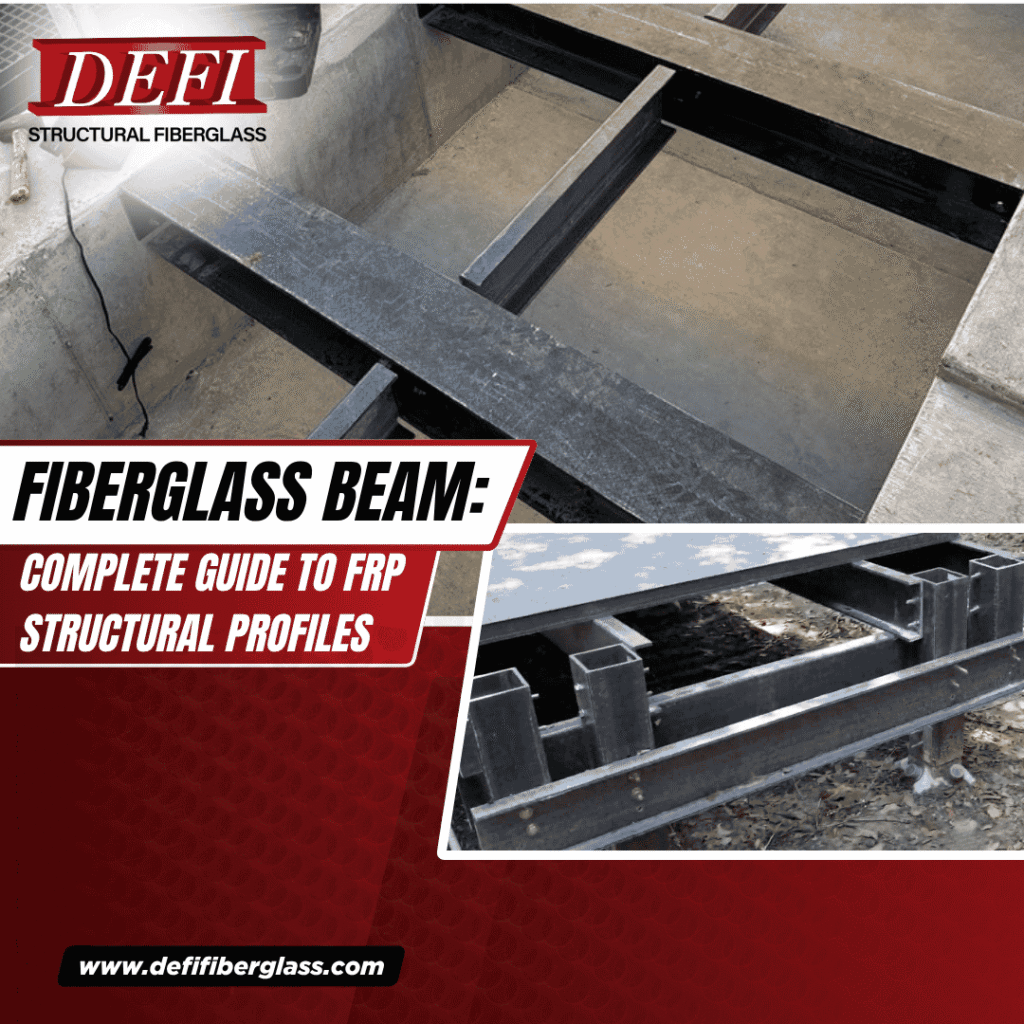
A fiberglass beam is a structural profile made from fiber-reinforced polymer (FRP) that provides load-bearing support in corrosive environments where steel fails. These pultruded beams, available as I-beams, H-beams, channels, and wide flange profiles, weigh 75% less than steel while delivering comparable tensile strength of 30,000 PSI and complete resistance to rust, chemicals, and moisture.
Key takeaways:
Fiberglass beams are manufactured through pultrusion, combining glass fibers with thermosetting resin for structural strength
Common profiles include I-beams (3-12 inches), channels, H-beams, and wide flange beams for walkways, platforms, and support structures
FRP beams offer corrosion resistance superior to steel in wastewater, chemical processing, and marine environments
Standard beams provide tensile strength of 30,000 PSI with a modulus of elasticity around 2.5 million PSI
Installation costs run lower than steel due to reduced weight and elimination of corrosion protection requirements
What Is a Fiberglass Beam?
A fiberglass beam is a structural FRP product composed of continuous glass fibers embedded in a polymer resin matrix. The manufacturing process, called pultrusion, pulls raw fiberglass rovings through a resin bath, then through a heated die that shapes and cures the material into structural profiles.
These beams typically include three distinct layers. The chemical barrier layer (CBL) provides resistance to acids, alkalis, and solvents. The structural layer delivers load-bearing capacity and temperature resistance. The surface veil protects against UV degradation and fiber bloom while maintaining a smooth finish.
Types of Fiberglass Beams
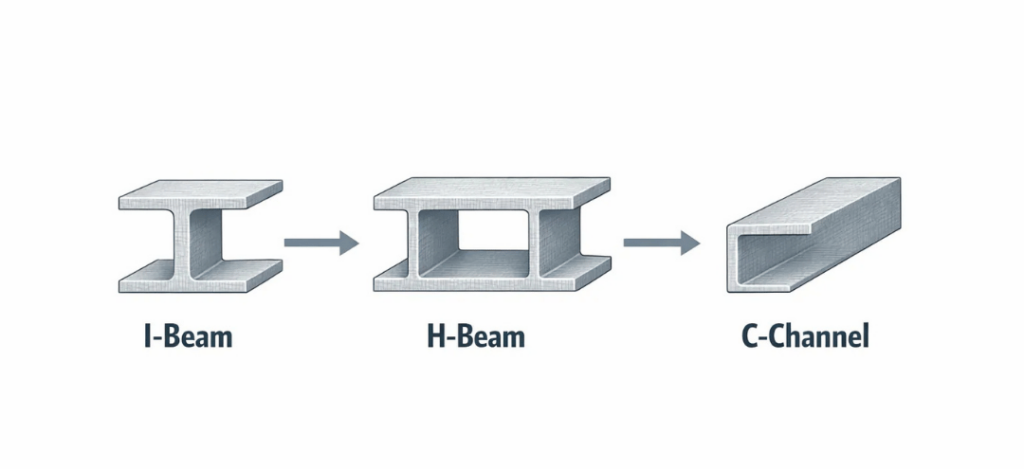
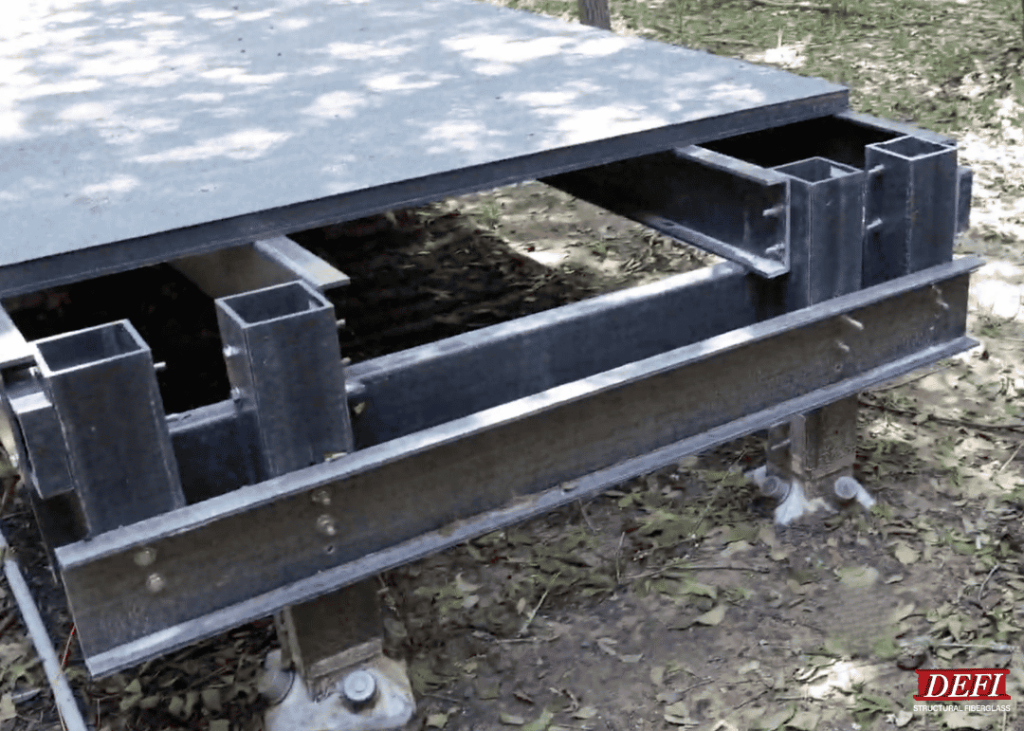
The fiberglass I-beam is the most efficient structural shape for applications requiring high load-bearing capacity with minimal material. The I-shaped cross-section places material at the top and bottom flanges where bending stress is greatest, with a vertical web connecting them.
Standard I-beam sizes range from 3 inches to 12 inches in depth, with flange widths typically 40-60% of the depth. Fiberglass I-beams provide flexural strength between 30,000-40,000 PSI depending on resin selection and fiber orientation. The American Society for Testing and Materials (ASTM) provides standards for testing FRP structural properties, ensuring consistent performance across manufacturers.
Common applications include support beams for platforms, structural frames for equipment, and load-bearing members in walkway assemblies where corrosion resistance matters more than absolute stiffness.
Fiberglass H-Beams
H-beams feature wider flanges than I-beams, creating a cross-section where the flange width equals or exceeds the web depth. This geometry distributes loads more evenly and provides superior lateral stability for compression applications.
H-beams serve as primary structural members in tank farms, support frames for grating systems, and load bars for stair assemblies where the wider flange provides better connection points for fasteners.
Fiberglass Channel Beams
Channel beams (C-channels or U-channels) feature a C-shaped cross-section with two flanges extending from a single web. This profile works well for edge support, stiffening applications, and situations where one side requires accessibility.
Channels provide excellent torsional rigidity when used as stiffeners for panels or as edge trim for fiberglass grating installations. The open profile allows drainage and prevents moisture accumulation in outdoor applications.
Standard channel depths range from 2 inches to 10 inches, with leg lengths proportional to depth. The shape makes channels ideal for slide rails, guide tracks, and perimeter supports where the C-shape captures an edge.
Wide Flange Beams
Wide flange beams represent a variation of the I-beam with significantly broader flanges, approaching an H-beam configuration but maintaining the traditional I-beam designation in many applications. The wider flanges increase resistance to lateral-torsional buckling and provide more surface area for connections.
These beams excel in applications requiring long spans with minimal deflection, particularly for supporting heavy equipment or FRP walkways in industrial facilities.
Specifications and Properties
Mechanical Properties
Fiberglass structural beams deliver specific mechanical properties that differ from steel in important ways:
| Property | Fiberglass Beam | Steel (A-36) |
|---|---|---|
| Tensile Strength | 30,000 PSI | 60,000 PSI |
| Compressive Strength (lengthwise) | 30,000 PSI | 36,000 PSI (yield) |
| Modulus of Elasticity | 2.5 million PSI | 29 million PSI |
| Density | 1.7-2.0 g/cm³ | 7.85 g/cm³ |
| Thermal Expansion | 8-12 × 10⁻⁶/°C | 11.7 × 10⁻⁶/°C |
A 10×5 inch fiberglass I-beam weighs approximately 11 pounds per foot versus 44 pounds per foot for equivalent steel.
Size Ranges and Dimensions
Manufacturers produce fiberglass beams in standard sizes to match common steel profiles:
I-Beams:
Depths: 3″, 4″, 6″, 8″, 10″, 12″
Flange widths: 2″-8″
Web thickness: 0.25″-0.50″
Standard lengths: 20′, 24′, 40′ (custom lengths available)
H-Beams:
Depths: 4″-24″
Flange widths: 4″-12″
Standard lengths: up to 48′
Channels:
Depths: 2″-10″
Leg lengths: 1″-4″
Standard lengths: 20′, 40′
Custom sizes accommodate project-specific load requirements. DEFI Fiberglass designs and manufactures custom FRP solutions for applications where standard profiles don’t meet span or load criteria.
Load Capacity and Deflection
Calculating deflection for fiberglass beams requires accounting for both flexural and shear components. Unlike steel where shear deflection is negligible, FRP beams may experience 15-30% of total deflection from shear stress due to the lower shear modulus.
For a simply supported beam with uniform load:
Total Deflection = Flexural Deflection + Shear Deflection
A 6×3 inch I-beam spanning 10 feet with a 500-pound uniform load typically deflects 0.4-0.6 inches, acceptable for industrial platforms where L/240 deflection limits apply. Engineers should consult manufacturer load tables for specific profiles and spans.
Color and Finish Options
Standard fiberglass beams come in gray, which contains UV inhibitors to prevent resin degradation. Green profiles serve applications requiring visual distinction for safety or organizational purposes.
The gel coat or surface veil provides a smooth, non-porous finish that resists dirt accumulation and simplifies cleaning in food processing or pharmaceutical facilities. Custom colors are available on large orders to match corporate standards or color-coded systems.
Corrosion Resistance Benefits
Chemical Resistance
Fiberglass beams maintain structural integrity when exposed to chemicals that rapidly corrode steel. The resin selection determines specific chemical resistance:
Polyester resin resists:
Weak acids and alkalis
Saltwater and brine solutions
Petroleum products
Most solvents
Vinyl ester resin provides superior resistance to:
Strong acids (sulfuric, hydrochloric, nitric)
Chlorine and hypochlorite solutions
Industrial solvents
High-temperature chemicals
FRP laminates resist most industrial chemicals and will not crack, chip, peel, rust, rot, or decay like traditional materials. The Composites Manufacturing Association reports that properly selected FRP can withstand pH levels from 1 to 14 with minimal degradation.
Wastewater and Marine Environments
Wastewater treatment facilities create the harshest corrosive conditions, combining hydrogen sulfide gas, sulfuric acid formation, constant moisture, and chlorine exposure. Steel beams in these environments corrode through in 5-10 years even with protective coatings.
FRP structural components last 25-50 years in wastewater applications without maintenance. DEFI Fiberglass has installed structural systems in dosing areas, clarifier walkways, and tank bunds where galvanized steel failed within 36 months.
Marine environments, offshore platforms, docks, splash zones, expose structures to salt spray that penetrates coatings and accelerates galvanic corrosion. Fiberglass beams remain unaffected by saltwater, eliminating the ongoing cost of surface preparation, coating, and replacement that steel requires.
Applications for Fiberglass Beams
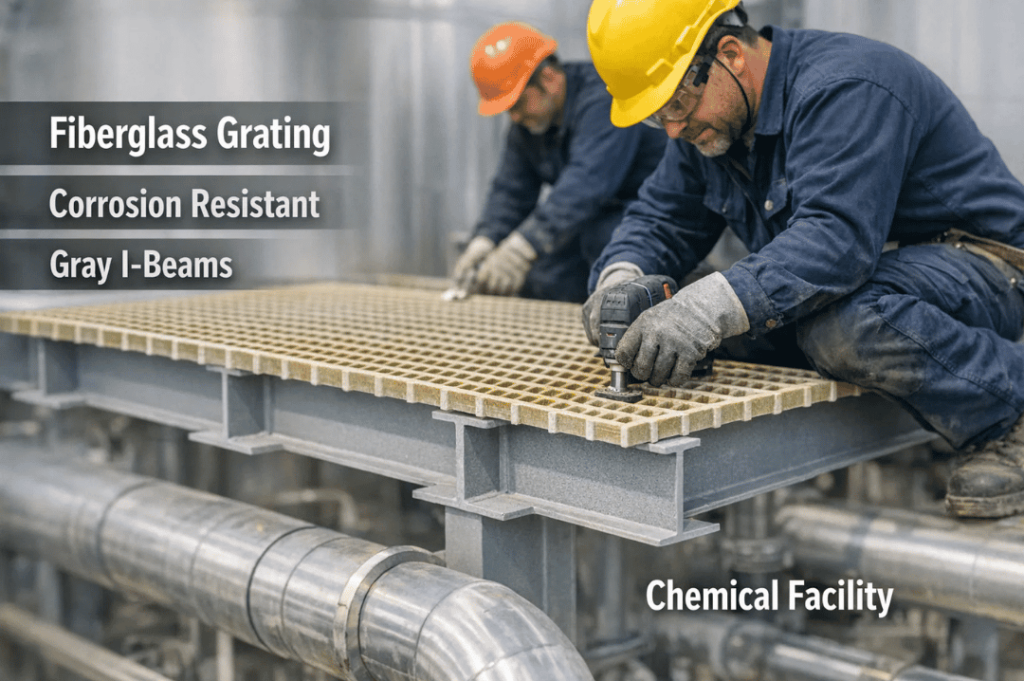
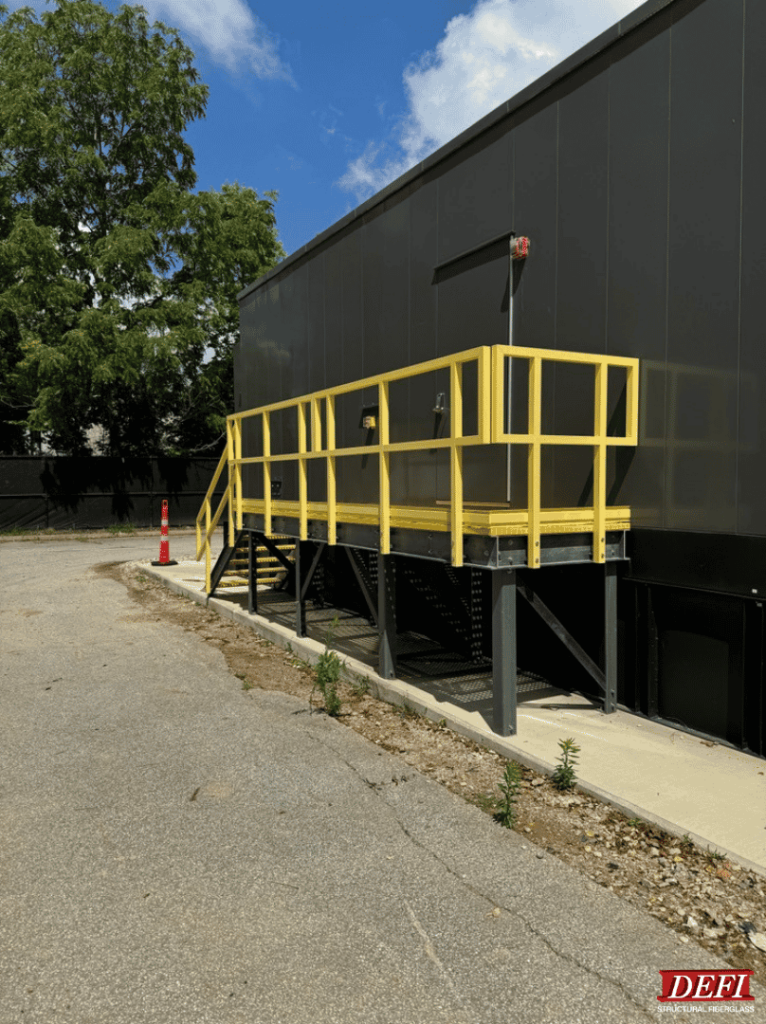
Elevated platforms and walkways in chemical plants, refineries, and water treatment facilities use fiberglass I-beams as primary support members. The beams create a structural frame that supports grating panels while providing access for maintenance.
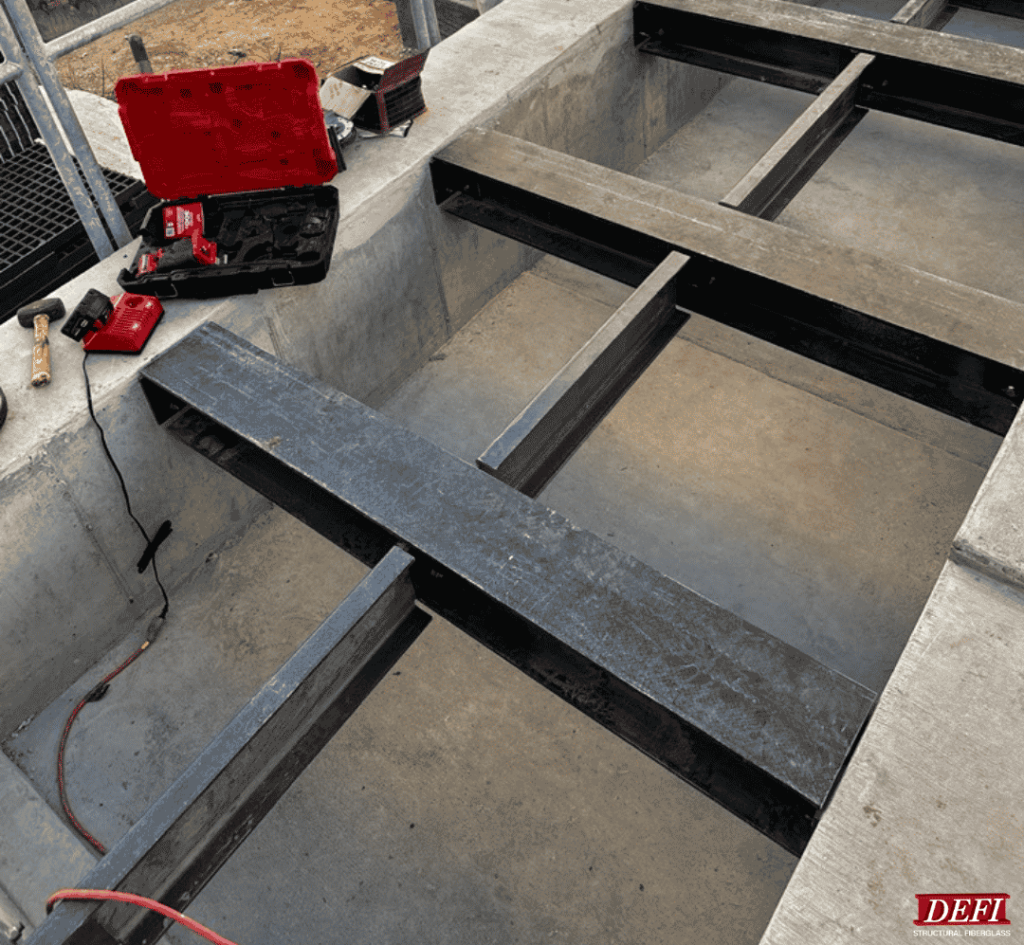
A typical platform design uses 8-inch or 10-inch I-beams spanning between support columns, with perpendicular 6-inch beams at 4-foot centers supporting the grating. This configuration handles loads of 100-150 PSF for personnel access plus equipment.
The corrosion resistance eliminates painting schedules and structural inspections required for steel, reducing lifecycle costs by 40-60% according to DEFI’s cost analysis.
Stair Assemblies and Handrails
Fiberglass beams serve as stringers for stair assemblies, supporting fiberglass stair treads in corrosive environments. Channel beams work well as stringers, with the C-shape providing easy mounting for treads and allowing drainage.
The non-conductive properties of FRP protect workers on stairs near electrical equipment, a critical safety advantage over aluminum or steel. Fiberglass handrail systems attach to beam structures using stainless steel fasteners that won’t create galvanic corrosion.
Support Structures and Frames
H-beams and I-beams form structural frames for equipment mounting, pipe racks, cable trays, and generator platforms. The lightweight material simplifies installation in areas with limited crane access or roof-mounted applications where load limits matter.
Data center applications particularly benefit from FRP’s electromagnetic transparency, fiberglass beams don’t interfere with sensitive electronic equipment or wireless communications.
Custom Fabrications
Louisiana Structural Fiberglass, DEFI’s fabrication division, assembles fiberglass beams into complete ready-to-install structures. Custom fabrications include:
Tank access platforms
Equipment skids and frames
Cathodic protection frames
Specialty enclosures
Pre-fabrication reduces field installation time by 50-70% compared to stick-built steel, delivering completed structures that bolt together on-site with minimal tools.
Fiberglass Beam vs. Steel Comparison
Weight Advantages
A fiberglass beam weighs 75% less than the equivalent steel profile. For a 20-foot section of 10×5 inch I-beam:
Steel weight: 880 pounds
Fiberglass weight: 220 pounds
This difference eliminates crane requirements for many installations, allows two workers to handle sections that would require mechanical lifting in steel, and reduces structural loading on elevated supports.
Offshore platforms, rooftop installations, and retrofit projects gain particular advantage from the weight savings. Projects in oil and gas applications often specify FRP to minimize platform loading and extend structure life.
Long-Term Cost Analysis
Initial material costs for fiberglass beams run 1.5-2.5 times higher than equivalent steel profiles. The total ownership cost, however, strongly favors FRP:
Steel beam lifecycle costs (20 years):
Initial material: $100
Installation (heavier): $150
Painting (3 cycles): $180
Inspection and maintenance: $120
Replacement (year 15): $100
Total: $650
Fiberglass beam lifecycle costs (20 years):
Initial material: $200
Installation (lighter): $80
Maintenance: $0
Replacement: $0
Total: $280
The 57% cost savings over 20 years comes primarily from eliminating corrosion protection and the longer service life, FRP can last 50+ years in corrosive environments.
Installation Considerations
Fiberglass beams cut and drill with standard carpentry tools. A circular saw with carbide blade makes clean cuts, and standard drill bits create holes for bolts. Wear a dust mask when cutting to avoid inhaling fine glass fibers.
Connections use stainless steel bolts, typically 3/8″ or 1/2″ diameter, with flat washers to distribute load. Never weld fiberglass, mechanical fasteners provide all connections. Pre-drilling holes slightly larger than bolt diameter (1/16″ oversize) accommodates thermal expansion.
Unlike steel, fiberglass beams don’t require surface preparation, priming, or painting before installation. The material arrives job-ready and installs in a fraction of the time steel requires.
Selecting the Right Fiberglass Beam
Load Requirements
Start with the load calculation: dead load (structure weight) plus live load (personnel, equipment, snow). Add a 50% safety factor for industrial applications. Determine the span between supports and identify whether the beam operates in bending or compression.
Consult load tables for allowable loads at specific spans. If standard profiles don’t meet requirements, custom extrusions or reinforced profiles may be necessary.
Environmental Factors
Match the resin system to the chemical exposure:
Polyester resin: General industrial, mild chemicals, outdoor exposure
Vinyl ester resin: Strong acids, wastewater, aggressive chemicals, elevated temperatures
Phenolic resin: Fire-retardant requirements, smoke-sensitive areas
Temperature ranges affect performance. Standard beams serve -40°F to 200°F. Higher temperatures require specialty resins or reduced load allowances.
Profile Selection
Choose the profile based on application:
I-beams: General purpose structural spans, most efficient for bending loads
H-beams: Compression members, wider flanges for lateral stability
Channels: Edge support, stiffeners, applications requiring drainage
Wide flange: Long spans, reduced deflection, equipment mounting
For FRP grating support, I-beams at 24-48 inch centers typically provide adequate support. Stair stringers work best with channels. Vertical columns prefer H-beam or square tube profiles.
Maintenance and Durability
Fiberglass beams require minimal maintenance compared to steel. An annual inspection checks for impact damage, connection tightness, and surface condition. Cleaning with soap and water removes accumulated dirt or process residue.
UV exposure gradually fades the surface color, but UV-stabilized resins protect the structural integrity. If fading concerns you aesthetically, a topcoat of polyurethane paint every 5-10 years restores appearance without affecting performance.
The fiber bloom mentioned in DEFI’s technical documentation occasionally appears as white fibers on cut edges or areas where the surface veil was removed. This doesn’t indicate structural degradation, simply sand smooth and apply sealant if needed.
Structural FRP maintains its load-bearing capacity for decades. DEFI has platforms installed in wastewater facilities since the 1990s that remain structurally sound, while the steel they replaced failed multiple times.
Why Use FRP Instead of Steel Rebar?
Fiberglass reinforced polymer (FRP) rebar outperforms steel rebar in concrete applications where corrosion threatens structural integrity. Steel rebar corrodes when chlorides penetrate concrete in bridge decks, parking structures, and marine pilings, causing concrete to crack and spall as the steel expands.
FRP rebar eliminates corrosion entirely, it won’t rust regardless of chloride exposure or low concrete cover. The National Association of Corrosion Engineers (NACE) estimates corrosion costs $2.5 trillion annually in the United States, with concrete reinforcement failures representing a significant portion.
FRP rebar weighs one-quarter of steel rebar, reducing handling costs and allowing longer lengths without splicing. The material is transparent to electromagnetic signals, making it ideal for structures near radar installations, airport runways, or MRI facilities where steel would cause interference.
According to ACI 440.1R, the American Concrete Institute’s guide to FRP reinforcement, fiberglass rebar provides tensile strength comparable to steel (up to 90,000 PSI for some grades) with superior fatigue resistance. The lower modulus of elasticity requires adjusted design procedures, but results in structures that outperform steel in corrosive environments by 50+ years.
Frequently Asked Questions
How strong is a fiberglass beam compared to steel?
Fiberglass beams provide 30,000 PSI tensile strength versus 60,000 PSI for steel. However, pound-for-pound, fiberglass is stronger in the lengthwise direction because you need 4 pounds of steel to match the load capacity of 1 pound of fiberglass. The lower modulus of elasticity means fiberglass beams deflect more under load, so spans are typically 20-30% shorter than steel for the same deflection limit.
Can you weld fiberglass beams?
No. Fiberglass is a thermoset material that doesn’t melt and reform. All connections use mechanical fasteners, stainless steel bolts with washers, drilled through the material. Adhesive bonding works for some applications but requires surface preparation and curing time. Mechanical fasteners provide the most reliable field connections.
Do fiberglass beams conduct electricity?
Fiberglass beams are non-conductive with high dielectric strength, making them ideal for electrical environments. This property protects workers near high-voltage equipment and prevents stray current corrosion in grounding systems. The EMI/RFI transparency also means FRP doesn’t interfere with electronic equipment or wireless signals.
What is the longest span for a fiberglass beam?
Span capability depends on the beam depth, load, and acceptable deflection. A 12-inch I-beam can span 15-20 feet for typical platform loads (100 PSF) with L/240 deflection. Longer spans require deeper custom profiles or intermediate supports. Engineers should calculate deflection for both flexural and shear components when designing FRP spans.
How do you cut and drill fiberglass beams?
Use carbide-tipped circular saw blades or metal-cutting blades to cut fiberglass beams. Drill with standard twist drill bits at moderate speed. Always wear a dust mask and eye protection, fiberglass creates fine dust when cut. Cut edges can be sealed with polyurethane or epoxy to prevent moisture absorption, though pultruded beams are solid throughout and don’t require edge sealing for structural purposes.
Get Expert Guidance on Fiberglass Beams
Selecting the right structural profile requires evaluating loads, spans, environmental exposure, and connection details. DEFI Fiberglass provides engineering support for project-specific applications, helping you determine the optimal beam size and configuration for your requirements.
Our team has decades of experience with pultruded fiberglass in corrosive industrial environments, from petrochemical facilities to wastewater treatment plants. We supply standard profiles from stock and manufacture custom structural assemblies through Louisiana Structural Fiberglass.
Request a quote for your next project. Our technical staff will review your specifications, recommend appropriate beam profiles, and provide load tables specific to your application. With Gulf Coast manufacturing and distribution, we deliver solutions designed for durability in the toughest conditions.
Learn more about structural FRP products or contact DEFI to discuss your specific requirements.
Check out our resources page here.
Follow us on LinkedIn!