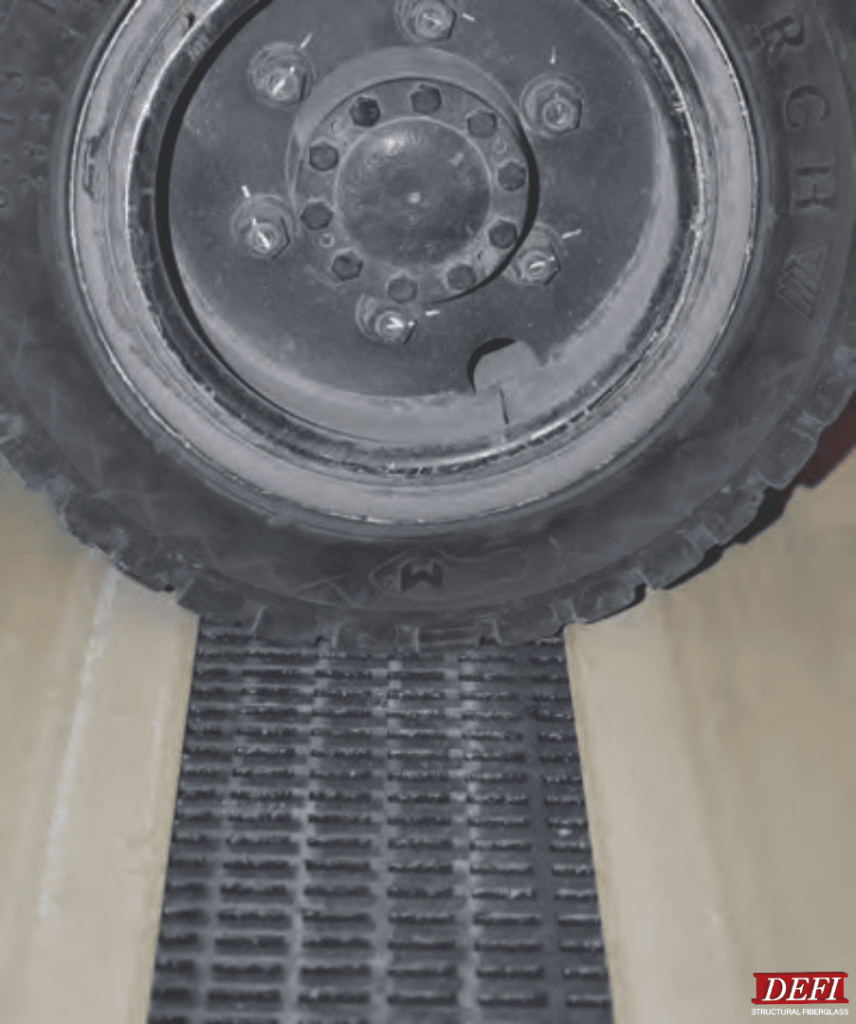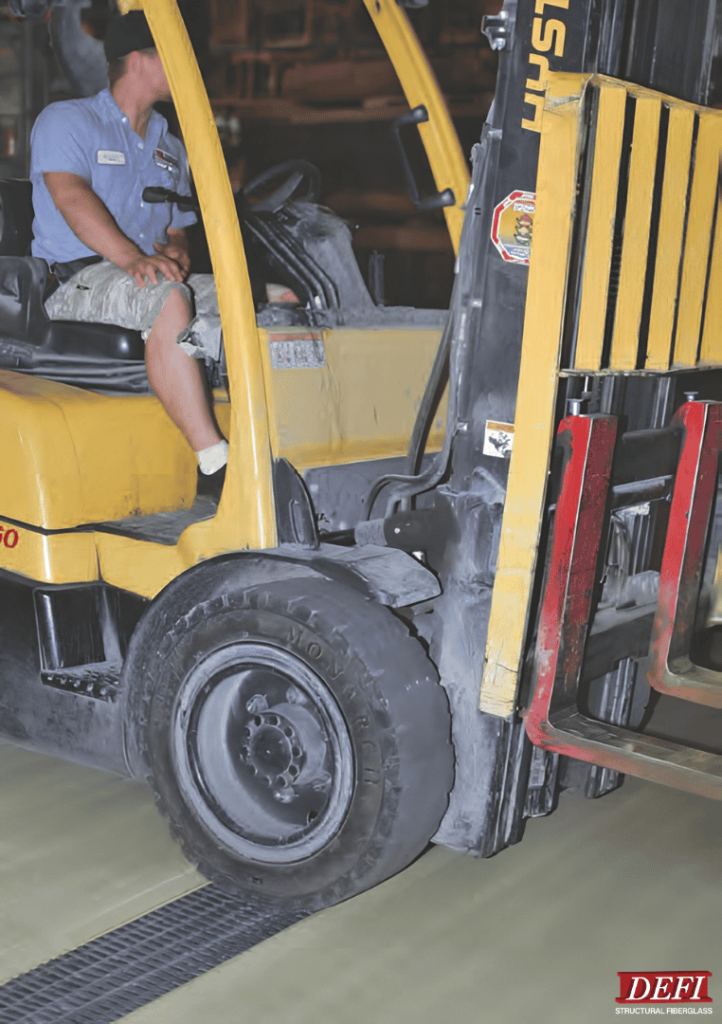
FRP grating trench covers generally outlast cast concrete, polymer concrete and metal trench drain systems in corrosive industrial settings. The fiberglass and resin matrix resists acids, caustics and salts all the way through. It doesn’t rely on a coating that eventually wears off. For facilities handling chemicals, wastewater or saltwater spray, the material behind trench drains for concrete decides how often the system gets repaired, recoated or torn out.
Key takeaways:
-
Plain concrete is porous and needs periodic sealing; without it, water and chemicals soak in and cause cracking, spalling and chipping, according to DEFI’s FRP lifespan guide.
-
Precast and polymer concrete systems resist many chemicals and hold up structurally, but their metal frames and grates can still corrode where chemistry or moisture is constant.
-
FRP grating covers don’t rust, rot or corrode.
-
FRP structures can last more than 75 years in highly corrosive environments with minimal maintenance, per DEFI, versus the recurring recoating or repair cycles concrete and steel systems need.
-
The right choice depends on chemical exposure, installation conditions and lifecycle cost, not just the price of the channel itself.
Why Trench Drain Material Matters in Corrosive Environments
The material you pick for trench drain systems decides whether they need attention every few years or barely need attention at all. In plants that handle acids, caustics, solvents or saline wastewater, that difference compounds fast across every drain system on site.
Whenever caustics, acids, bases or solvents flow into a drain, the materials in that system have to be matched to the chemical load, and that means reviewing independent test data before committing to a product rather than assuming “concrete” or “metal” is good enough.
Concrete sewer and wastewater infrastructure is a documented case study in what happens when that match is wrong. A 2024 review in Science of the Total Environment found that bio-corrosion, where hydrogen sulfide gas converts to sulfuric acid on exposed concrete surfaces, costs the sewer industry billions of dollars in maintenance and shortens the service life of concrete structures worldwide, according to the study. That’s the chemistry a trench drain cover has to survive too, not just carry weight over.
How Concrete Trench Drains Perform Under Chemical Exposure
Concrete trench drains carry heavy loads reliably, but plain concrete is vulnerable to the same chemical and biological attack that erodes concrete sewers unless it’s sealed, coated or formulated specifically to resist it.
Plain poured concrete is porous. Without coatings or sealants, water and dissolved chemicals work into the pores and cause cracking, spalling and chipping over time, and those coatings have to be reapplied on a cycle, per DEFI’s breakdown of how building materials compare. That upkeep is the trade-off for concrete’s upfront affordability and strength.
Manufacturers have responded with reinforced alternatives. A.J. Foss positions precast concrete trench drains as the strongest, most cost-effective option for harsh climates, built to handle vehicular traffic and resist UV degradation better than plastic channel drains, which the company notes aren’t rated for vehicle weight unless encased in concrete. Precast sections run up to 20 inches tall and 24 inches wide, in 2, 3, 4 and 6-foot lengths. Using a precast polyester polymer concrete composite the company describes as stronger than plain concrete and resistant to many chemicals. Typical modular concrete drain channels for commercial sites run 4.8, 8 or 12 inches wide, which is why polymer concrete shows up so often in chemical-exposure specs.
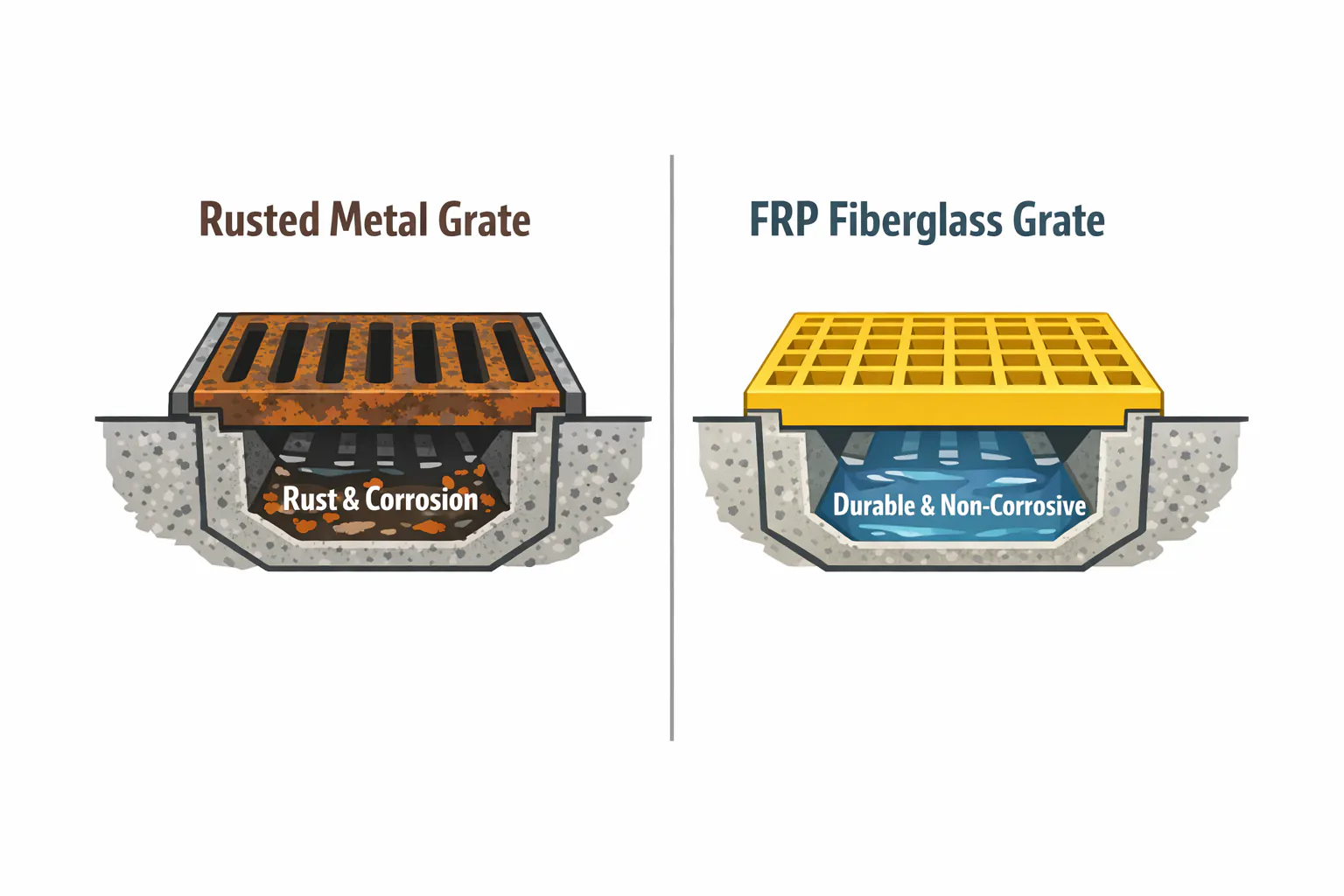
The gap in both approaches is the metal. Grates, frames and wearing edges on concrete and polymer-concrete channels are commonly cast iron or steel. Metal corrodes without ongoing coatings or galvanizing, and it cracks or breaks down eventually, as DEFI notes in its materials comparison. A concrete drain channel with a corroding metal grate is only as chemical-resistant as its weakest part.
FRP Trench Covers: Corrosion Resistance and Durability
FRP grating covers resist acids, bases, salts and solvents because the resin, not a surface coating, is what gives the material its chemical resistance. Nothing has to wear through before corrosion starts, because there’s no separate protective layer to fail.
DEFI builds its pultruded and molded FRP grating from fiberglass strands combined with polyester, epoxy or vinyl ester resin. Vinyl ester is generally regarded as the most corrosion-resistant option, according to DEFI’s own FRP lifespan analysis. That page reports FRP structures lasting more than 75 years in highly corrosive settings, with only occasional cleaning required, no galvanizing and no recoating.
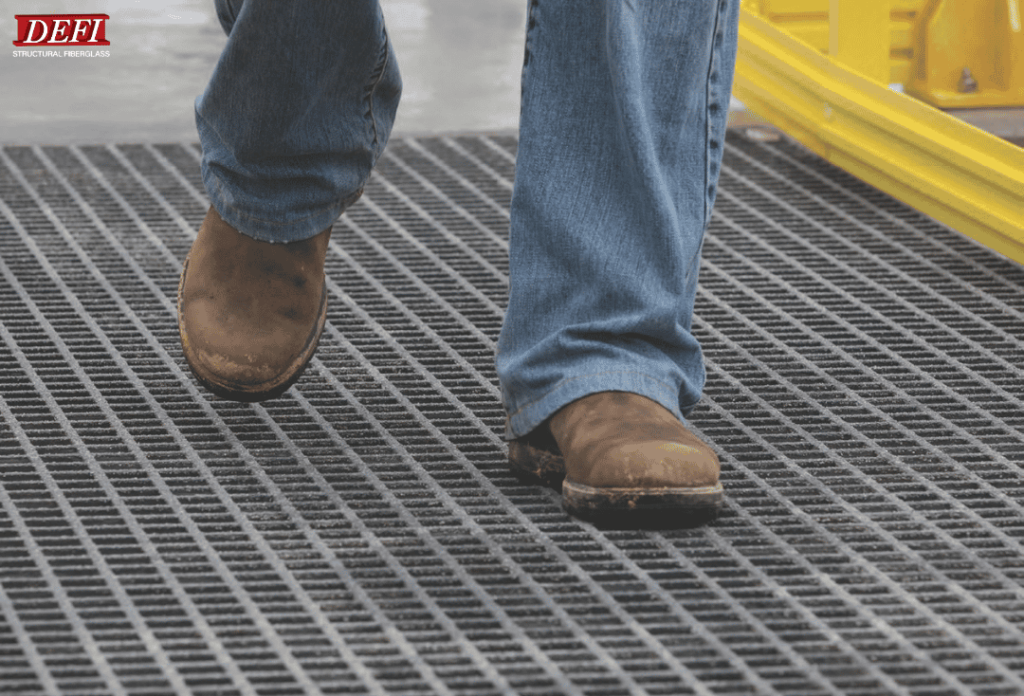
DEFI makes two grating lines relevant to trench applications. Its VGBA-certified grating is built for pump shacks, drainage decks and splash park structures exposed to corrosive pool chemicals, and it’s independently lab-tested to ASME A112.19.8.a for UV resistance. Its pultruded phenolic grating adds fire resistance with low smoke and toxic-gas emissions, built for refineries, offshore rigs and other high-hazard zones where a chemical-resistant trench drain cover also has to meet fire codes. Both come with a grit-top anti-skid surface as standard, and stock panels pair with 316 stainless steel clips and hardware for the fastening side of the design. That combination matters on a trench cover that’s going to be walked on while wet.
Comparing Cost, Maintenance and Lifespan
Here’s how the main trench drain materials stack up on what actually drives lifecycle cost in a corrosive facility:
|
Material |
Upfront cost |
Ongoing maintenance |
Chemical resistance |
Corrosion weak point |
|---|---|---|---|---|
|
Plain / cast-in-place concrete |
Lowest |
Periodic sealing & crack repair (DEFI) |
Moderate; porous without sealant |
Cracking, spalling, chipping |
|
Precast / polymer concrete |
Moderate-high |
Joint and grate upkeep |
Good to strong, chemical-dependent |
Metal frames/grates still corrode |
|
Steel or cast-iron grates & frames |
Low-moderate |
Recoating or galvanizing cycles (DEFI) |
Poor without coating |
Rust, pitting, cracking |
|
FRP grating trench covers |
Moderate |
Occasional cleaning only (DEFI) |
High, resin-based all the way through |
None reported in corrosive service |
The pattern: concrete and metal systems trade a lower sticker price for a maintenance schedule, while FRP shifts more of the cost to the purchase and less to the next twenty years of upkeep. For a facility running acids or saline wastewater continuously, that trade usually favors FRP on total cost of ownership even when the per-foot material price is higher.
Where FRP Grating Covers Fit Best
FRP grating covers make the most sense anywhere a trench is exposed to constant moisture, chemicals, or electrical risk, not in every application. Light-duty residential driveway drainage rarely needs it; a continuously wet chemical pad almost always does.
That’s why DEFI’s FRP and fiberglass products get specified across water and wastewater treatment facilities, petrochemical plants, offshore platforms, agriculture operations and amusement and water parks, the same corrosive, high-moisture settings where metal and unsealed concrete struggle most. The material’s non-conductive property also adds a layer of electrical safety that concrete and steel trench covers can’t match, which matters around pump stations, substations and generator pads. For covered trenches where visibility matters in low light, FRP grating is also available in fluorescent or brightly colored finishes that make the floor edge easier to see.
FRP’s weight advantage adds up during installation, too. DEFI’s structural FRP profiles run roughly 70 to 75 percent lighter than steel, and vinyl ester FRP has shown corrosion rates below 0.001 mm per year with service lives past 30 years without recoating, according to DEFI’s structural FRP guide. Lighter covers and frames mean less rigging and fewer crew members needed to swap a trench cover during a shutdown.
Browse DEFI’s FRP grating options to see the molded, pultruded and phenolic lines available for trench and access cover applications.
Choosing the Right Trench Cover for Your Facility
The right trench cover material comes down to four questions: what chemicals and moisture will it see, what traffic will cross it, is it going into new concrete or an existing slab, and what you’re willing to spend on upkeep over the next decade.
-
Chemical exposure first. Match the cover material to the actual chemistry in the trench, not a general assumption that “concrete is tough” or “metal is strong.” A quick way to sanity-check this is reviewing independent resistance data the way.
-
Traffic and location. Pedestrian and light equipment areas have more cover options than drive lanes carrying heavy vehicles.
-
New pour vs. retrofit. Trench covers and embed angles can be set into new concrete during the pour, or retrofitted into an existing trench edge with the right hardware, so an older slab doesn’t rule out upgrading to FRP.
-
Lifecycle cost, not just price per foot. A cheaper cover that needs resealing or regalvanizing every few years can cost more over ten years than a higher-priced FRP cover that doesn’t.
If your facility deals with corrosive chemicals, constant moisture or electrical safety concerns, request a free quote and DEFI’s team will size the design to your trench dimensions, loading and exposure, whether it’s a new commercial pour or a retrofit kit for an existing channel.
FAQ
What is a good heavy-duty trench drain for concrete?
For heavy vehicular or industrial traffic, a precast or polymer concrete channel with a securely fastened cover handles the load well, but the cover material still needs to match the chemical environment. In corrosive plants, an FRP grating cover over a concrete or polymer-concrete channel combines structural support with a cover that won’t rust or pit.
What is the best trench drain material?
There’s no single best material for every site. Plain concrete is the most affordable but needs sealing; polymer concrete resists more chemicals and loads; cast iron and steel grates are strong but need recoating; FRP grating covers resist corrosion without coatings or galvanizing and hold up longest in continuously wet or chemically aggressive settings, per DEFI’s materials comparison.
Can I install a trench drain in existing concrete?
Yes. Trenches can be cut into existing slabs and fitted with a channel system, or an existing trench edge can be retrofitted with an embed angle or frame to seat a new cover, including FRP grating, without repouring the whole slab.
How deep does a trench drain need to be?
Depth depends on the pipe size, slope and water volume the system needs to carry, which a civil or drainage engineer calculates per project; there’s no single standard depth that applies across residential, commercial and industrial installs.
Does FRP grating conduct electricity?
No. FRP is inherently non-conductive, which is one reason facilities use it around pump stations, substations and other equipment where electrical safety is a concern, in addition to its chemical resistance.
How long do FRP trench covers last compared to metal ones?
DEFI reports FRP structures lasting more than 75 years in highly corrosive environments with only occasional cleaning, while steel and cast iron need periodic coating or galvanizing to avoid rusting and eventually cracking, according to DEFI’s lifespan analysis.