The main stair nosing types are aluminum, steel (carbon or stainless) and fiberglass (FRP), each sold as a bolt-on strip or built into the tread itself. In corrosive or wet industrial settings, the material question matters more than the profile shape: a nosing that rusts, pits or wears smooth stops protecting anyone long before the stair structure fails.
This guide compares the three materials on wear, slip resistance and lifespan, without inventing load ratings or certifications that aren’t published. It also looks at why some facilities skip the retrofit nosing altogether and specify FRP stair treads with the anti-slip edge molded in.
Key takeaways:
Aluminum nosing resists general rust but is vulnerable to galvanic corrosion when bolted to steel or exposed to chemical splash.
Carbon steel nosing needs a coating (paint, galvanizing) to resist corrosion; once that coating is breached, rust spreads underneath it.
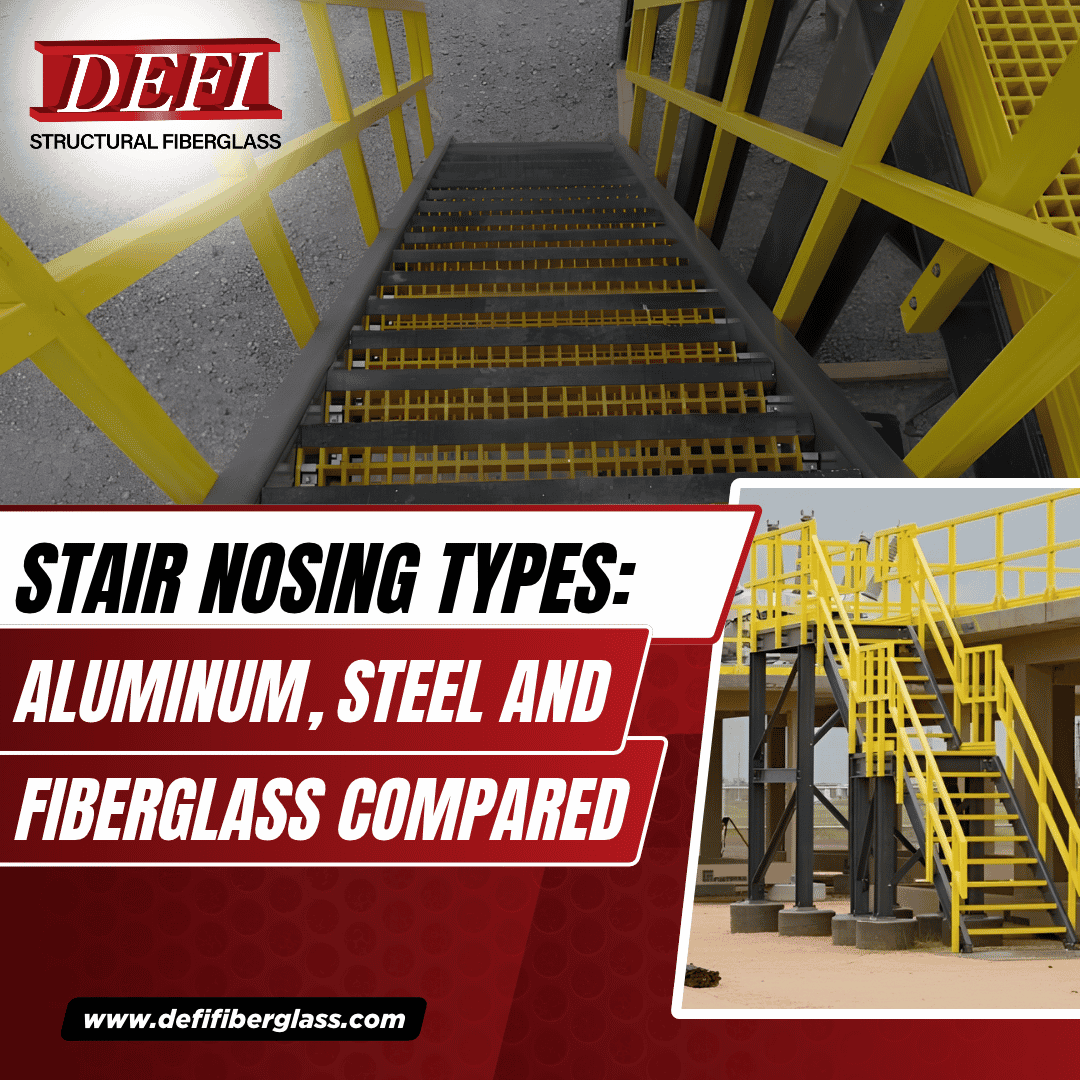
FRP stair treads built by DEFI Fiberglass come with a grit-top anti-skid surface as standard and a contrasting color nosing molded into the tread, not welded or bolted on afterward.
OSHA’s walking-working surfaces rule (1910.25) sets geometry and slip-resistance requirements for stairs; it does not mandate a specific nosing material, per OSHA 1910.25.
Retrofitting nosing onto a failing steel or wood stair buys time; replacing the whole assembly with FRP stair and railing assemblies removes the corrosion problem instead of patching around it.
What Is Stair Nosing and Why It Matters
Stair nosing is the front edge of a stair tread, the strip of material a foot lands on first going up or down. The part of the tread that provides extra surface area, improves visibility and is where non-slip material is most often added, because it’s the part of the stair that wears fastest.
That wear pattern is exactly why nosing matters. Foot traffic concentrates at the leading edge of every tread, so that edge loses its texture, its paint or its coating well before the rest of the stair shows damage. An anti slip nosing keeps that worn edge from becoming a slip hazard, and a visible, contrasting nosing helps workers judge each step at a glance, especially in low light or when carrying tools.
OSHA’s general industry stairway standard requires uniform riser heights and tread depths, adequate structural capacity, and handrails on standard stairs, under 1910.25. The rule governs stair geometry and general safety, not a specific nosing material or finish, so the material choice is left to the facility.
Beyond material, there are several types of stair nosing profiles regardless of what the nosing is made of: flush nosing sits level with the tread, squared nosing has a sharp 90-degree edge, and bullnose (or pencil-round) nosing rounds the front edge for a softer transition. Thickness and size vary by manufacturer and application, from thin retrofit strips to nosing that’s installed as an integral part of the tread. These profile choices apply whether the staircase is in a home, a commercial lobby, or an industrial facility; the design tradeoffs around corrosion resistance and maintenance are what change based on the environment.
Aluminum Stair Nosing: Pros and Cons
Aluminum nosing is lightweight, easy to cut and install, and naturally resists surface rust because of the oxide layer that forms on its surface.
The tradeoff is galvanic corrosion. Aluminum nosing bolted or welded to steel grating, or exposed to saltwater, acids or caustic washdown, can corrode quickly where the two metals meet, since aluminum sits lower on the galvanic scale than steel or stainless steel. It also dents and scratches more easily than steel, and a damaged edge loses its anti-slip texture.
Best fit: indoor or mild outdoor settings with moderate traffic, where weight savings matter and chemical exposure is limited.
Steel Stair Nosing: Pros and Cons
Steel nosing, usually carbon steel or stainless steel, is the toughest option under foot traffic and impact. McNICHOLS offers it in checkered plate and cast abrasive patterns, welded as a 90-degree angle onto the leading edge of a bar grating stair tread. Stainless steel nosing resists corrosion far better than carbon steel and holds up well in washdown or marine air, per Clickmetal’s comparison, but it costs more.
Carbon steel nosing is the cheapest option up front, but it corrodes without a protective coating. Galvanizing or painting slows that process, not stops it: once the coating chips or wears through at the high-traffic edge (the exact spot nosing is meant to protect), rust undermines the surface from beneath, and the checkered pattern can turn slick once the diamond texture wears down.
Best fit: dry, low-corrosion indoor environments where upfront cost outweighs long-term maintenance, or stainless steel where budget allows and corrosion exposure is moderate.
Fiberglass (FRP) Stair Nosing: Pros and Cons
FRP stair nosing doesn’t corrode, because the material itself (fiberglass reinforced with resin) has no metal to rust or pit, even under constant chemical or saltwater exposure. DEFI Fiberglass builds that anti-skid nosing into the tread during manufacturing rather than welding or bolting a separate strip onto a finished stair, and FRP stair treads typically ship with contrasting color nosing molded in for step recognition.
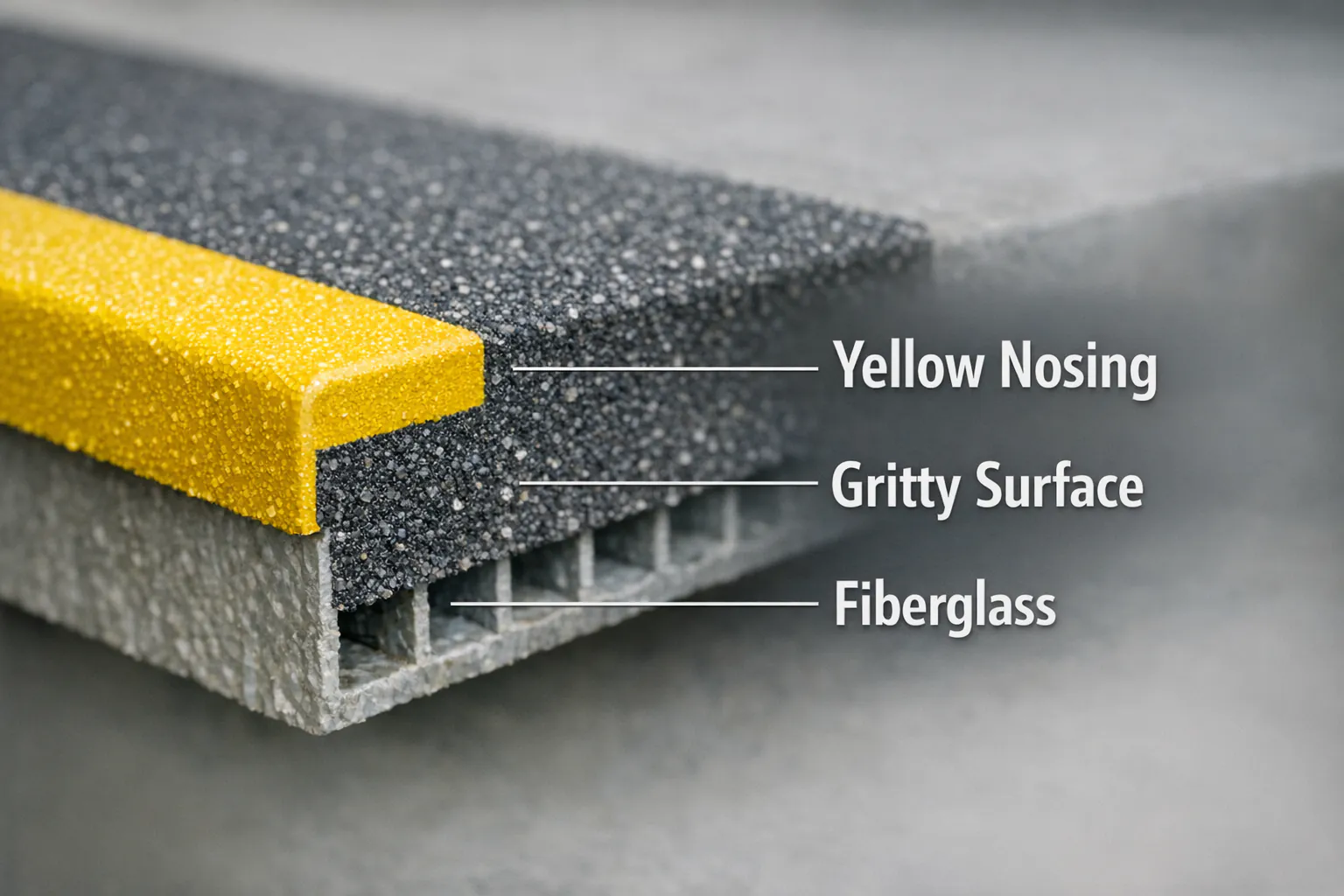
The grit-top surface is standard on DEFI’s pultruded grating, and the grip is customizable to the environment, including conditions where oil or other slick substances are a daily hazard. Because the color and texture run through the material rather than sitting on top as a coating, wear doesn’t expose a different, less safe surface underneath the way it does on painted or coated metal.
FRP nosing isn’t the cheapest option by sticker price, and it’s a different installation process than welding a metal angle onto an existing stair. It’s also a different material to specify if a facility’s engineering standards are written around steel or aluminum accessories. For corrosive, wet or chemically exposed environments, those tradeoffs are usually worth it.
Best fit: water and wastewater plants, petrochemical and oil and gas facilities, offshore platforms, and any site where corrosion, not foot traffic alone, is what eventually takes a stair out of service.
Comparing Durability in Corrosive Environments
Wood nosing fares worse than either metal here: moisture causes rot long before steel corrodes through, which is why facilities with wet or humid staircases avoid wood options for industrial stair safety specs entirely. The table below focuses on the three materials used most in those specs today.
Factor | Aluminum nosing | Steel nosing | FRP nosing |
|---|---|---|---|
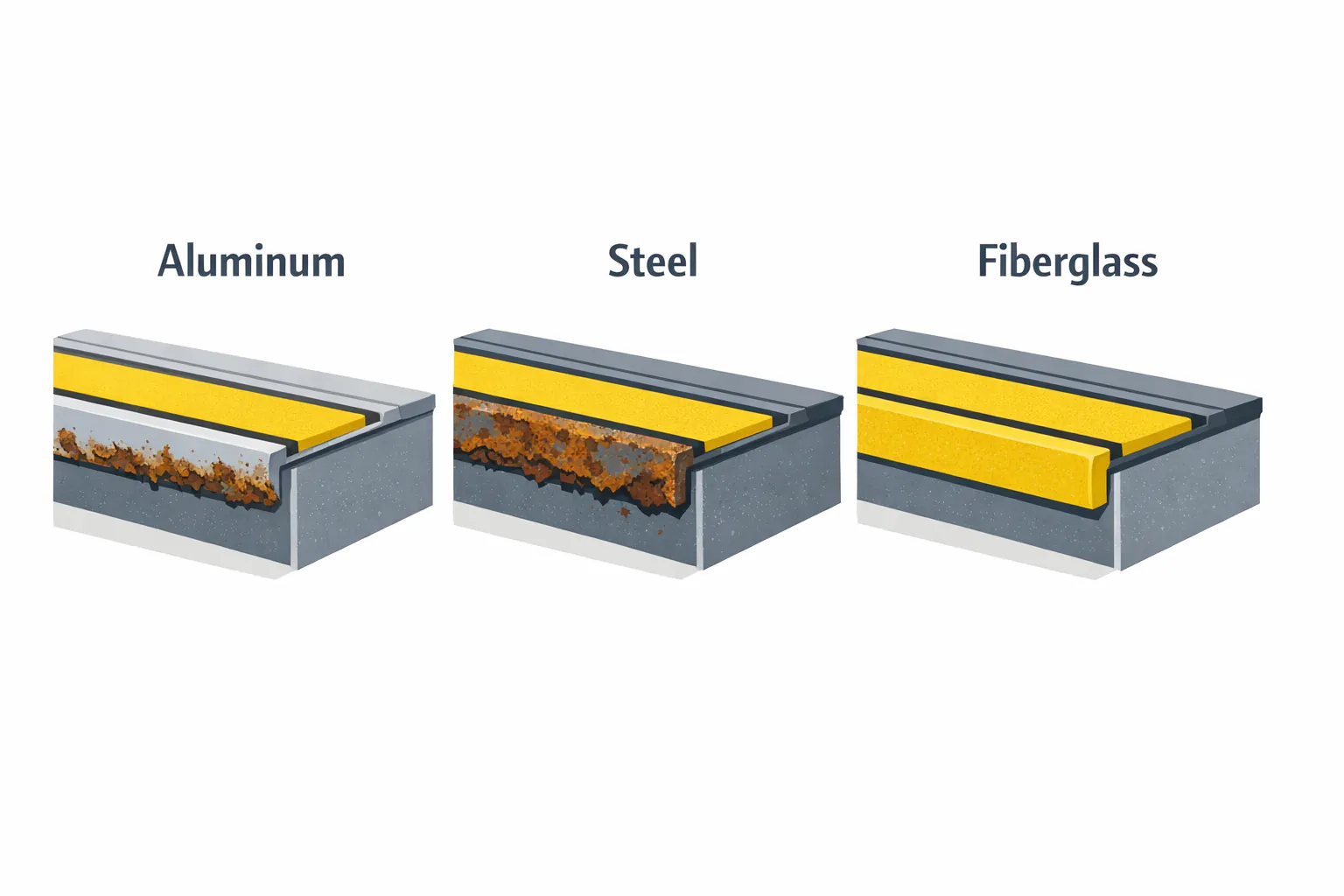
Corrosion resistance | Resists surface rust; vulnerable to galvanic corrosion against dissimilar metals | Carbon steel corrodes once coating fails; stainless resists better but costs more | Does not corrode; material has no metal to rust, per DEFI’s FRP lifespan guide |
Weight | Lightest metal option | Heaviest of the three | Lightweight, comparable to aluminum |
Slip resistance | Good when cast abrasive or grit-coated; smooths with wear | Good on checkered or grit patterns; slick once worn or wet | Grit-top anti-skid surface standard, with customizable grip |
Wear pattern | Dents and scratches; texture wears at the leading edge | Coating wears first, exposing bare metal to rust | Texture and color run through the material, not just the surface |
Maintenance | Low in dry settings; monitor dissimilar-metal contact points | Needs recoating or galvanizing upkeep | Practically maintenance-free, per DEFI |
Electrical conductivity | Conductive | Conductive | Non-conductive |
FRP structures can last more than 75 years even in highly corrosive environments, according to DEFI’s own data on FRP lifespan, compared with steel that needs ongoing coatings and treatments to avoid rust once exposed to moisture or chemicals.
Choosing the Right Nosing Material for Industrial Facilities
The right nosing material depends on what’s actually attacking the stair: foot traffic, chemical exposure, moisture, or all three at once. A dry, indoor stair with light traffic can run on steel or aluminum nosing for years without issue. A stair exposed to saltwater, acids, caustic washdown or constant humidity is a different problem, and that’s where corrosion resistant stairs built from FRP stop being a specialty choice and start being the practical one.
Facility engineers weighing the advantages of each offering should look at total cost over the staircase’s service life, not just sticker price. That calculus changes the design of a stair meant to last decades in a corrosive plant versus one in a dry commercial office lobby.
Facility and procurement teams should weigh corrosivity, traffic volume, maintenance budget and electrical conductivity needs together, not nosing in isolation. FRP’s non-conductive nature matters near substations and electrical work, and treating nosing as a standalone accessory decision misses that the tread, the nosing and the stringer all age together on the same staircase.
When to Consider FRP Stair Assemblies Instead of Retrofitting Nosing
Retrofitting new nosing onto a corroding steel or rotting wood stair is a short-term fix. It addresses the one edge that’s already failed, not the stair that’s corroding or decaying around it. If the original material is the problem, a new strip of aluminum or steel nosing is solving the symptom in the wrong place.
Replacing the whole staircase addresses the corrosion driving the safety issue instead of patching the one edge that already failed.
It’s worth switching to a complete FRP stair assembly instead of retrofitting nosing when a facility notices any of these:
The stair is in a chemical, wastewater, offshore or coastal environment where metal corrodes faster than the maintenance budget can keep up with repainting or replacing it.
Nosing keeps needing replacement because the base material underneath it keeps failing.
Electrical non-conductivity is a safety requirement, which rules metal nosing and metal stairs out entirely.
The facility wants to cut long-term maintenance labor rather than keep recoating or rewelding stair components.
DEFI Fiberglass builds FRP stair and railing assemblies with the anti-skid, contrasting-color nosing molded into every tread, shipped ready-to-assemble so a crew can install it with hand tools instead of specialty welding equipment. For facilities weighing a full stair replacement against another round of nosing repairs, that’s the calculation worth running first: request a free quote and compare the real cost of patching against replacing.
FAQ
What are the different styles of stair nosing?
Common styles include flush nosing (level with the tread), square-edge nosing, bullnose (a rounded front edge), checkered or diamond plate, cast abrasive, corrugated, and grit-coated metal strips. Material options span aluminum, carbon steel, stainless steel, rubber, and FRP covers checkered plate, slip-resistant metal, rubber and taped-on nosing as the four most common non-material-specific styles.
What is the standard nosing for stairs?
There’s no single mandated nosing style; OSHA’s stairway rule (1910.25) sets geometry and general safety requirements for stairs but leaves the nosing material and profile to the facility. In practice, checkered plate and grit-coated metal nosing are the most common retrofit options, while FRP stair treads build the anti-skid edge into the tread itself.
What is the best type of nosing for stairs?
The best type depends on the environment. For dry, low-traffic indoor stairs, steel or aluminum nosing is usually adequate. For corrosive, wet, chemically exposed or electrically sensitive environments, FRP stair treads hold up longer because the material itself doesn’t rust, pit or need recoating.
What are the differences between bullnose and stair nosing?
Bullnose is a specific nosing profile, a rounded front edge on the tread, while “stair nosing” is the general term for the entire leading edge component regardless of its shape. A stair can have flush, square or bullnose nosing; bullnose is one shape option among several, and the material (aluminum, steel, FRP) is a separate choice from the profile.
Does aluminum nosing rust?
Aluminum resists general surface rust because of its natural oxide layer, but it’s susceptible to galvanic corrosion when it contacts a more noble metal like steel or stainless steel in the presence of moisture, which is a common nosing installation scenario since nosing is often fastened to a different metal.
Why do facilities choose FRP stair treads over metal nosing retrofits?
Because FRP doesn’t give facilities a corrosion problem to manage in the first place. DEFI Fiberglass’s stair assemblies are built with the anti-skid nosing molded into the tread, not added afterward, so there’s no coating or weld joint for corrosion to attack at the exact spot that takes the most wear.
Is FRP nosing non-conductive?
Yes. Fiberglass and the resins used to make FRP are inherently non-conductive, which is a meaningful safety factor around substations, transformers and other electrical work where metal stair components are a shock risk.
The Bottom Line
Nosing material matters more than nosing shape once a stair sits in a corrosive or wet environment. Aluminum and steel nosing both work, until the coating, the galvanic contact point, or the base metal underneath starts to fail, and then the facility is back to repairing or replacing it. FRP stair treads sidestep that cycle because the anti-skid, contrasting-color nosing is part of the tread, not a part bolted onto one.
For facilities comparing another nosing retrofit against a full stair replacement, DEFI Fiberglass builds complete FRP stair and railing assemblies shipped ready-to-assemble for water treatment, petrochemical, offshore, data center and other corrosive-environment facilities. Request a free quote to get a cost comparison for your site.