OSHA guardrail requirements set a top rail height of 42 inches (plus or minus 3 inches), a 200-pound strength standard, and a fall-protection trigger of 4 feet for general industry, under 29 CFR 1910.29(b) and 1910.28(b).
Construction sites follow an almost identical spec under 29 CFR 1926.502(b), but the trigger height changes to 6 feet under 1926.501(b)(1).
Below is what each rule actually says, where barricades fit (and where they don’t), and what to weigh when the guardrail has to survive years in a corrosive or wet environment.
Key takeaways
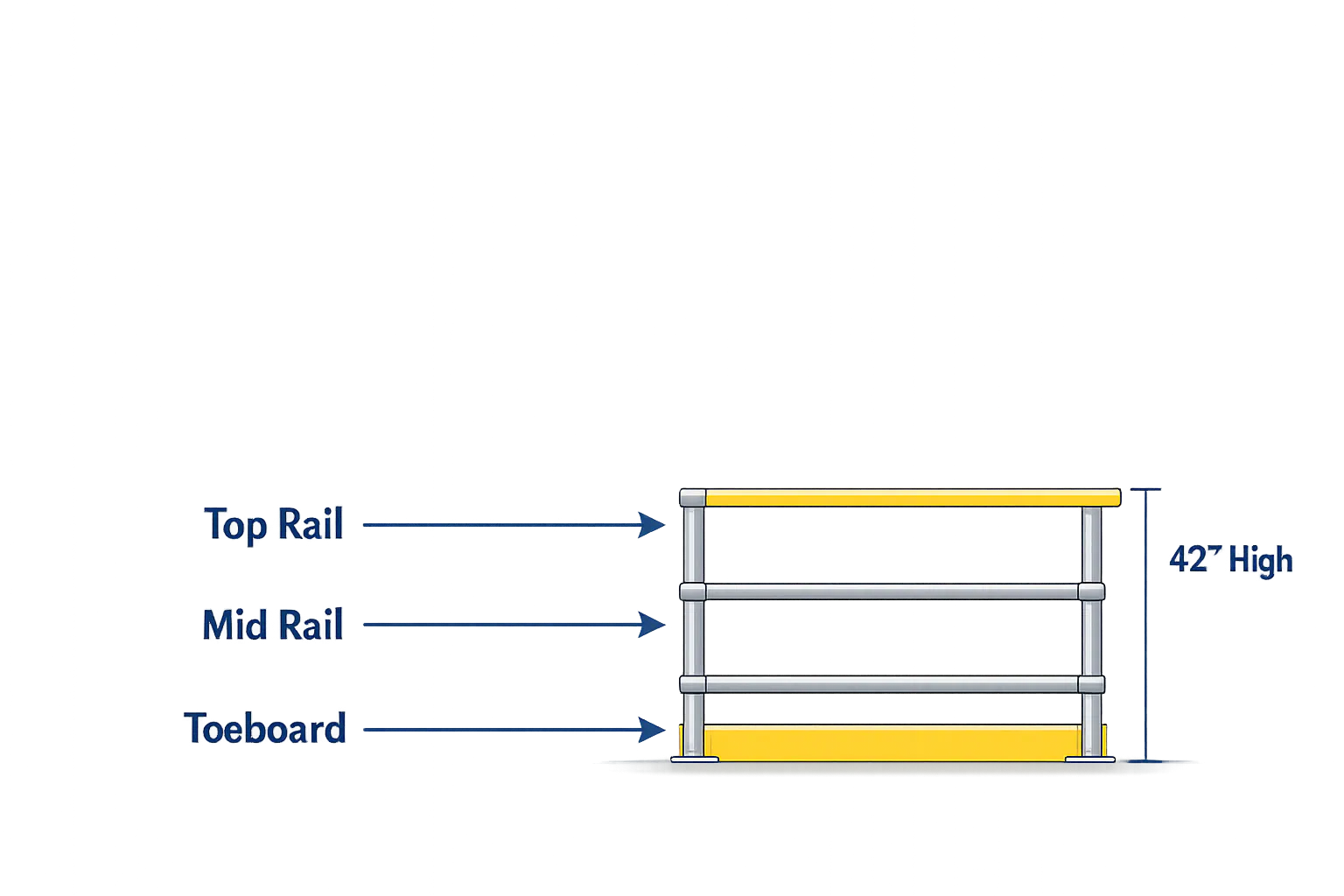
Top rail height: 42 inches, plus or minus 3 inches, under 1910.29(b)(1) and 1926.502(b)(1).
Fall protection trigger height: 4 feet in general industry (1910.28(b)), 6 feet in construction (1926.501(b)(1)).
Top rails must withstand 200 lbs of force; midrails must withstand 150 lbs, per 1910.29(b)(3).
“Barricades” are named by OSHA only as an option for excavations, wells, pits and shafts under 1926.501(b)(7), they are not a general substitute for a guardrail system.
OSHA sets dimensions and strength, not material. That leaves room to choose a corrosion resistant option like FRP for wet, chemical or offshore environments.
What OSHA Requires for Guardrails
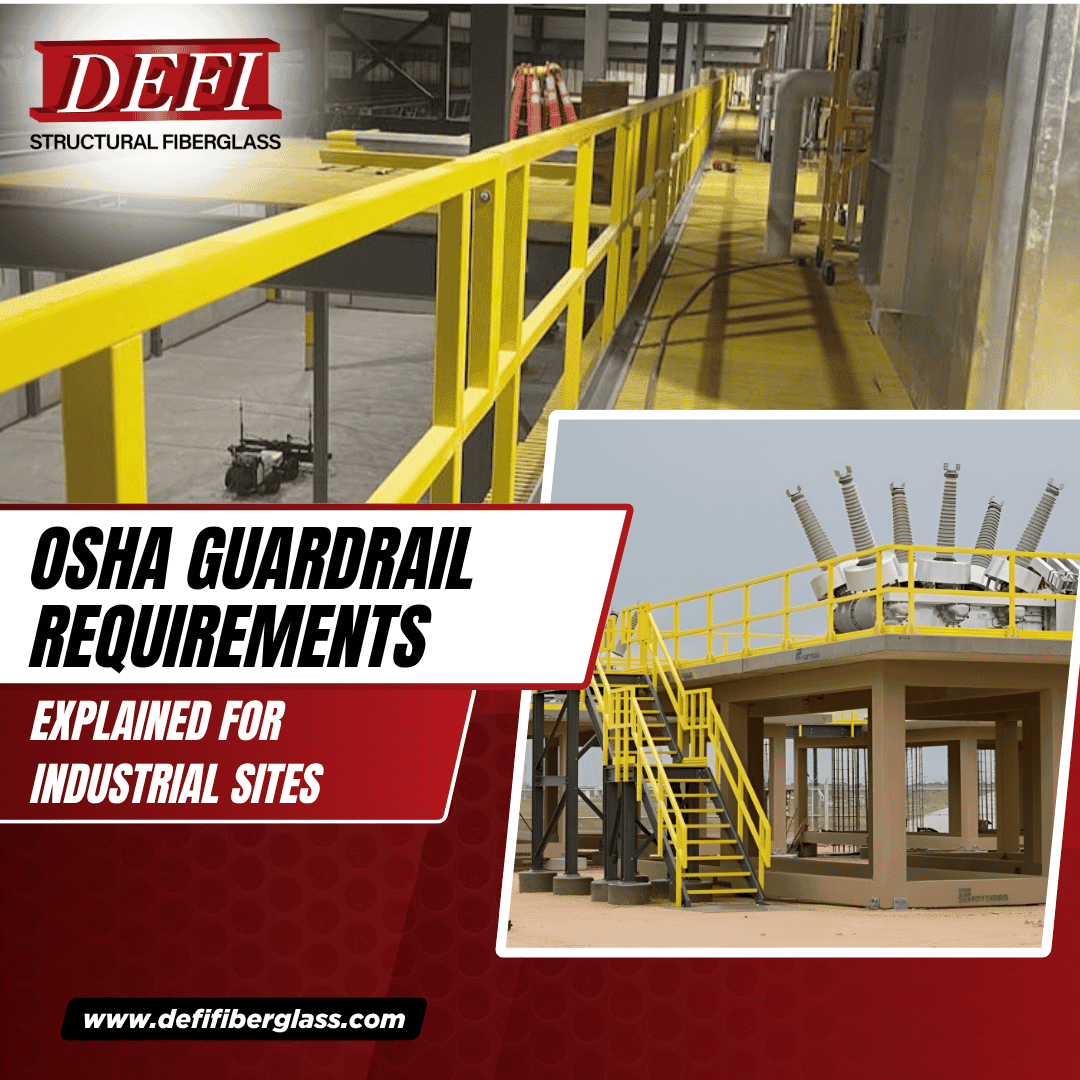
OSHA regulates guardrails under two parallel standards: 1910.29(b) for general industry and 1926.502(b) for construction. Both define a guardrail system as a barrier built from a top rail, usually a midrail, and posts, erected along an unprotected side or edge of a walking-working surface.
Both standards require the same core numbers: a 42-inch top rail height, a 200-pound strength threshold, and intermediate members spaced no more than 19 inches apart. They also share the same surfacing rule, guardrails must be smooth enough to prevent punctures, lacerations or snagged clothing, under 1910.29(b)(6) and the equivalent construction provision. Where the two diverge is the height at which fall protection becomes mandatory in the first place, covered below.
At What Height Do You Need a Guardrail
A guardrail (or an equivalent fall protection system) is required at 4 feet in general industry and at 6 feet in construction. These are two different OSHA standards, and the number depends on which one applies to the worksite.
Section 1910.28(b) requires a guardrail system, sometimes called safety railing, a safety net system, or a personal fall protection system on any walking-working surface with an unprotected side or edge 4 feet or more above a lower level. The same 4-foot trigger applies to hoist areas, dockboards and runways under that same section.
Construction work follows 1926.501(b)(1), which sets the trigger at 6 feet for unprotected sides and edges, and repeats that 6-foot threshold for leading edges, ramps, excavations and most other construction fall hazards in the rest of 1926.501(b).
Guardrail System Requirements: Height, Strength and Spacing
A compliant guardrail system has to hit specific numbers for height, load capacity and opening size, not just “a rail along the edge.” Here’s the spec sheet from 1910.29(b) and 1926.502(b), which are functionally the same for both general industry and construction:
Requirement | General industry (1910.29(b)) | Construction (1926.502(b)) |
|---|---|---|
Top rail height | 42 in, ±3 in above the surface | 42 in, ±3 in above the surface |
Midrail position | Midway between top rail and surface | Midway between top rail and surface |
Max opening (balusters/panels) | 19 in | 19 in |
Top rail strength | 200 lbs, downward/outward, within 2 in of the top edge | 200 lbs, downward/outward, within 2 in of the top edge |
Midrail strength | 150 lbs | 150 lbs |
Max deflection under load | Top edge can’t drop below 39 in | Top edge can’t drop below 39 in |
Minimum rail diameter/thickness | 0.25 in | 0.25 in (nominal) |
Banding materials | No steel or plastic banding as rails (1910.29(b)) | Same restriction |
OSHA’s own wording says a guardrail system must be capable of withstanding, without failure, a force of at least 200 pounds applied in a downward or outward direction within 2 inches of the top edge, at any point along the top rail. Midrails, screens, mesh, intermediate vertical members and other intermediate members must meet a lighter 150-pound version of the same test, and the gap between them can’t exceed 19 inches on a walking-working surface that doesn’t already have a wall or parapet at least 21 inches high.
Handrails and stair rail systems get their own height rule in 1910.29(f): handrails must sit between 30 and 38 inches above the leading edge of the stair tread, per 1910.29(f)(1)(i). Stair rail systems installed on or after January 17, 2017 must be at least 42 inches, under 1910.29(f)(1)(ii)(B), older stair rail systems installed before that date only needed 30 inches. Toeboards show up in a related but separate rule: 1910.28(b) requires them around ladderway floor holes and similar openings to stop tools and materials from falling to a lower level, on top of the guardrail itself.
OSHA Barricade Requirements vs Guardrail Requirements
OSHA does not maintain a standalone “barricade” standard that works like the guardrail rule. The word shows up in exactly one place in the fall protection standards: 1926.501(b)(7), covering excavations, wells, pits and shafts.
Under 1926.501(b)(7)(i), an employee at the edge of an excavation 6 feet or more deep must be protected by “guardrail systems, fences, or barricades” when the excavation isn’t easily seen because of plant growth or another visual obstruction. 1926.501(b)(7)(ii) extends the same list, plus covers, to wells, pits and shafts of the same depth.
That’s a narrow, named exception for a specific hazard type. It does not make a barricade an acceptable stand-in for a guardrail on a platform, mezzanine, catwalk or open-sided floor, those still have to meet the full height and strength spec in 1910.29(b) or 1926.502(b). The closest thing general industry has to a temporary barrier is the warning line system under 1910.29(d), used to mark a designated work area rather than physically stop a fall; it has its own rules (minimum 200-lb breaking strength, installed 34 to 39 inches high, visible from 25 feet) that are separate from, and lighter-duty than, a permanent guardrail system.
What Is the OSHA 4 Foot Rule
The “4-foot rule” is shorthand for 1910.28(b): in general industry, any unprotected side or edge 4 feet or more above a lower level needs a guardrail system, a safety net system, or a personal fall protection system. It is a general-industry number only, construction uses the 6-foot trigger in 1926.501(b)(1) instead.
The 4-foot line isn’t absolute. Holes less than 4 feet above a lower level still need a cover or guardrail against tripping, under the same section, and hoist areas, dockboards and runways each restate the same 4-foot threshold in their own part of 1910.28(b).
Choosing Guardrail Materials That Stay Compliant Long Term
OSHA’s guardrail rule specifies dimensions, load capacity and surface condition, it does not mandate a material. A guardrail built from steel, aluminum, wood or fiber-reinforced polymer (FRP) can all be built to meet 1910.29(b) or 1926.502(b) on day one. The harder question is whether it still meets that spec five or ten years into service on a site with chemical exposure, saltwater, high humidity or constant washdown.
That’s where material choice becomes a compliance question, not just a budget one. A rail that corrodes, pits, or loses section thickness can fall below the 0.25-inch minimum or the 200-pound strength threshold well before anyone schedules a re-inspection. DEFI Fiberglass builds FRP guardrail and handrail assemblies that are corrosion resistant and non-conductive by nature of the resin and glass-fiber construction, which is why they’re specified across water and wastewater treatment, petrochemical, offshore and agricultural sites where steel and aluminum are more exposed to that kind of long-term breakdown.
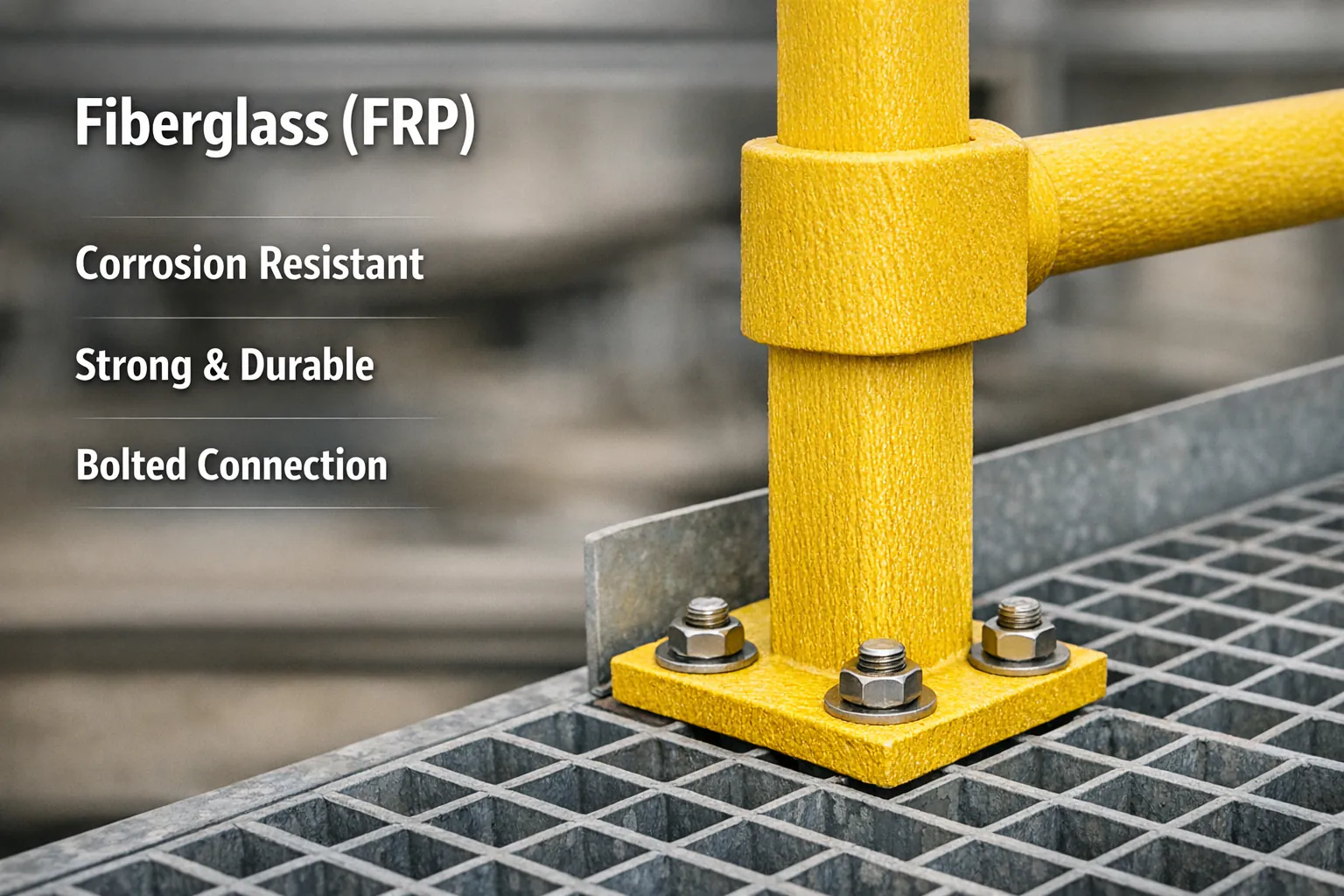
FRP is also lightweight relative to steel, which lowers freight costs and lets crews install guard rail systems with hand tools instead of heavy equipment. For sites that need documentation on file, DEFI also supplies OSHA certified fiberglass products built to the same 42-inch height and 200-pound load criteria covered above.
If an upcoming project needs guardrail, handrail or stair rail systems that hold their spec in a corrosive or wet environment, request a free quote through DEFI Fiberglass’s contact form.
FAQ
At what height do you need a guardrail?
In general industry, a guardrail is required at 4 feet or more above a lower level, under 1910.28(b). In construction, the trigger is 6 feet, under 1926.501(b)(1).
What are the requirements for guardrails?
A compliant guardrail system has a top rail 42 inches high (plus or minus 3 inches), a midrail at the midpoint, openings no wider than 19 inches, a top rail that resists 200 lbs of force, and a midrail that resists 150 lbs, per 1910.29(b) and 1926.502(b).
What are the OSHA barricade requirements?
OSHA only names barricades as an option for excavations, wells, pits and shafts 6 feet or more deep, under 1926.501(b)(7), alongside guardrails, fences or covers. There’s no separate barricade standard for general platforms or walkways; those still need a full guardrail system.
What is the OSHA 4 foot rule?
It’s the general-industry rule in 1910.28(b) requiring fall protection, a guardrail, safety net, or personal fall protection system, on any unprotected side or edge 4 feet or more above a lower level.
Do OSHA guardrail rules apply to handrails too?
Handrails and stair rail systems have their own height criteria under 1910.29(f): handrails sit 30 to 38 inches above the stair tread, and stair rail systems installed on or after January 17, 2017 must be at least 42 inches, per 1910.29(f)(1)(ii)(B).
Can older guardrails be grandfathered under a previous OSHA rule?
For stair rail systems specifically, yes: 1910.29(f)(1)(ii)(A) allows stair rail systems installed before January 17, 2017 to stay at the older 30-inch minimum, rather than the current 42-inch requirement.
Does OSHA require a specific guardrail material?
No. 1910.29(b) and 1926.502(b) set height, strength and surfacing requirements, not a required material, which is why corrosion resistant options like FRP are allowed anywhere a steel or aluminum rail would otherwise be used.