A high-strength pultruded fiberglass H-beam matches structural steel pound for pound on tensile strength, at roughly a quarter of the weight, which measures pultruded fiberglass profiles at up to 80% lighter than steel. Standard FRP structural shapes test at 30,000 PSI tensile and flexural strength lengthwise, the same range steel delivers. Buyers often search for this exact profile as a high strength pultruded fiberglass H beam, since the phrase describes the manufacturing process (pultrusion), the material (fiberglass), and the shape (H-beam) in one term.
The catch: you can’t swap an 8-inch steel H-beam for an identical 8-inch fiberglass one and expect matching deflection. Because FRP’s modulus of elasticity runs lower than steel’s, engineers typically spec the fiberglass member a size deeper or thicker to hit the same stiffness. Once sized correctly, it outperforms steel in every corrosive, electrically sensitive, or weight-restricted application.
Key takeaways:
- A high-strength pultruded fiberglass H-beam tests at 30,000 PSI tensile and flexural strength lengthwise, comparable to structural steel, per DEFI’s own structural profile data.
- It weighs about 75-80% less than an equivalent steel beam, cutting freight and crane costs.
- Dielectric strength runs around 200 volts/mil, making it a standard choice for electrical insulation around substations and high-voltage walkways.
- FRP H-beams don’t corrode, so they outlast steel by decades in wastewater, petrochemical, and marine environments.
- DEFI stocks and fabricates H-beams in bulk from two Gulf Coast plants, with custom sizing available through its Louisiana Structural Fiberglass division.
What Makes a Pultruded Fiberglass H-Beam “High Strength”?
A pultruded fiberglass H-beam gets its strength from continuous glass fiber rovings pulled through a resin bath and cured inside a heated die, a manufacturing process called pultrusion. The pultrusion process packs in a high volume of fiber and places it strategically along the profile, which is what gives the finished fiberglass FRP shape its strength and durability. The fibers run the length of the beam, which is why strength lengthwise is far higher than strength measured across the grain.
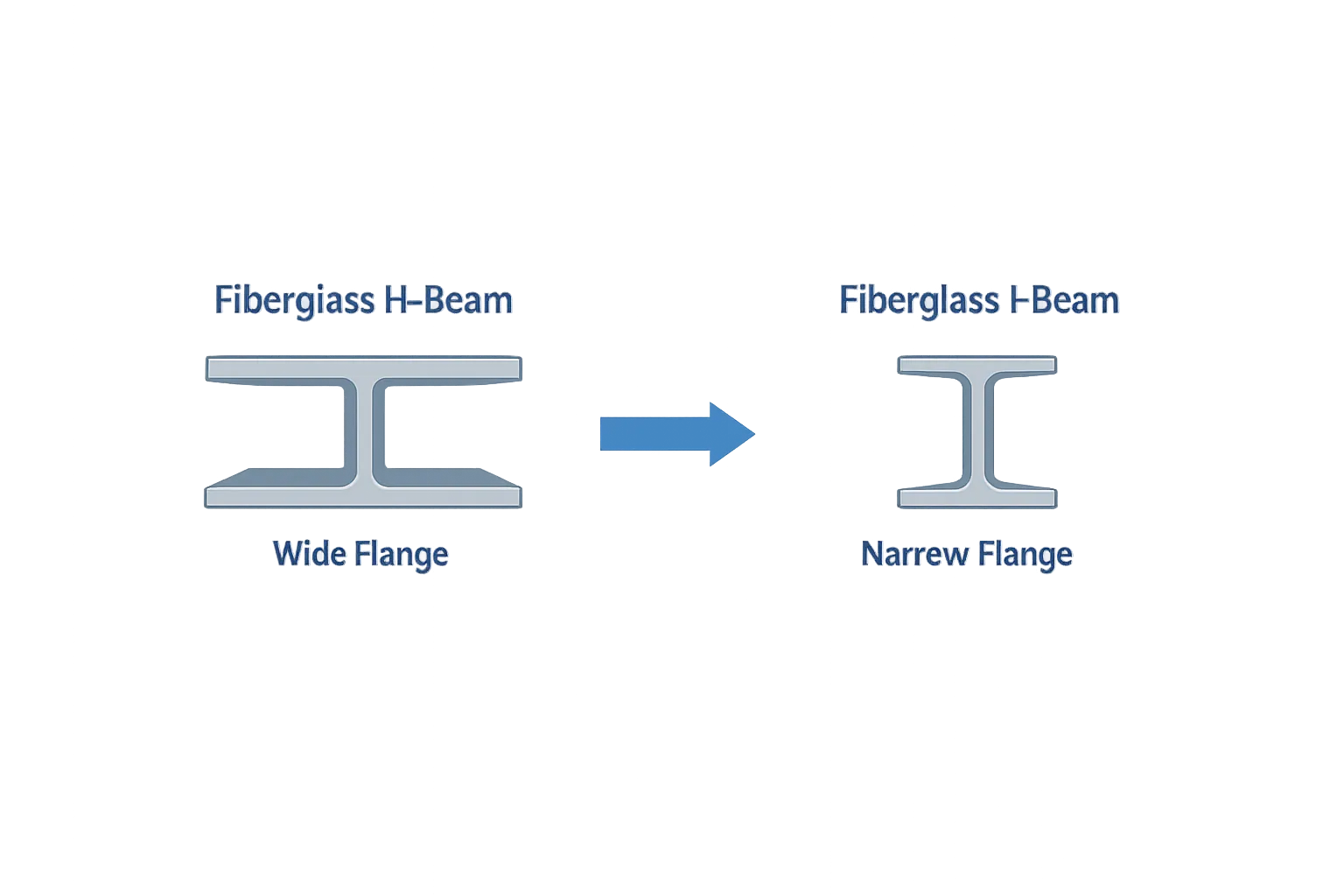
The H-beam shape itself matters too. Compared to an I-beam, an H-beam has flanges as wide as (or wider than) its web is deep. That wider flange spreads load more evenly and gives better lateral stability in beam design, which is why H-beams tend to show up as primary structural members, tank farm supports, and load bars rather than as simple bending members. Like other FRP structural profiles, H-beams are tested to ASTM standards for tensile, flexural, and compressive strength, which keeps FRP beams from different manufacturers within a predictable performance range for structural design work.
Structural FRP products like H-beams, I-beams, channels, and box sections have been specified for decades in aerospace and military programs specifically for their strength-to-weight ratio, long before the industrial market caught on.
Pultruded Fiberglass H-Beam Strength Specs
The numbers below come from standard coupon testing under ASTM methods, as reported by U.S. Plastic Corp and DEFI’s own fiberglass beam specifications.
| Property | Pultruded Fiberglass (lengthwise) | Structural Steel (A-36) |
|---|---|---|
| Tensile strength | 30,000 PSI | ~60,000 PSI |
| Flexural strength | 30,000 PSI | Comparable, varies by grade |
| Compressive strength | 30,000 PSI | 36,000 PSI (yield) |
| Modulus of elasticity | 2.5-2.8 million PSI | 29 million PSI |
| Dielectric strength | ~200 volts/mil | Conductive (0) |
| Density | 1.7-2.0 g/cm³ | 7.85 g/cm³ |
| Weight (comparable section) | ~75% lighter | Baseline |
Steel still wins on raw tensile numbers and stiffness per the modulus of elasticity, which is exactly why engineers spec a deeper or thicker fiberglass section rather than a straight swap. But on a strength-to-weight basis, and in any environment that corrodes or carries current, the fiberglass member wins the job. A 10×5-inch fiberglass I-beam, for comparison, runs about 11 pounds per foot versus 44 pounds per foot for the steel equivalent.
Electrical Insulation: Why FRP H-Beams Replace Steel Near High-Voltage Equipment
An FRP H-beam doesn’t conduct electricity, full stop. Independent testing puts its dielectric strength around 200 volts/mil measured perpendicular to the laminate, versus steel, which conducts and creates a shock hazard the moment it’s energized or grounded improperly.
That property is why pultruded H-beams show up as transformer mounting structures, substation platforms, and cable tray supports. DEFI’s own non-conductive FRP products are built around the same principle for substation and utility work.
The electromagnetic transparency carries a second benefit most buyers don’t think about until they need it: fiberglass structural members don’t interfere with sensitive electronics, which matters for data center generator platforms and telecom cable runs sitting right next to metal-free walkways.
Steel’s Key Weaknesses Compared to FRP H-Beams
Steel earned its position as the default structural material over a century of use, and it still has plenty of applications where it’s the right call. But in a few specific, common conditions, it loses to a fiberglass H-beam every time.
- Corrosives destroy it. Saltwater, sulfuric acid, and chlorides eat through carbon layers in steel, weakening load capacity over time. Coatings slow corrosion; they don’t stop it. FRP doesn’t react with any of it.
- It costs more once you add installation. Steel’s raw material price has eased some since the 2018 import tariffs, but moving and installing it still requires cranes and reinforced foundations. A fiberglass H-beam at roughly a quarter of the weight ships on standard freight and installs with hand tools.
- It’s rigid, not flexible. Steel resists bending under sustained load but dents under acute impact. FRP flexes slightly under impact instead of denting, and that same flex is easier on workers’ joints on platforms and stair assemblies.
- It conducts electricity. Covered above, and it’s the single biggest reason plant engineers spec FRP near substations, electrical rooms, and waterparks with heavy electrical infrastructure.
Where Pultruded Fiberglass H-Beams Get Used
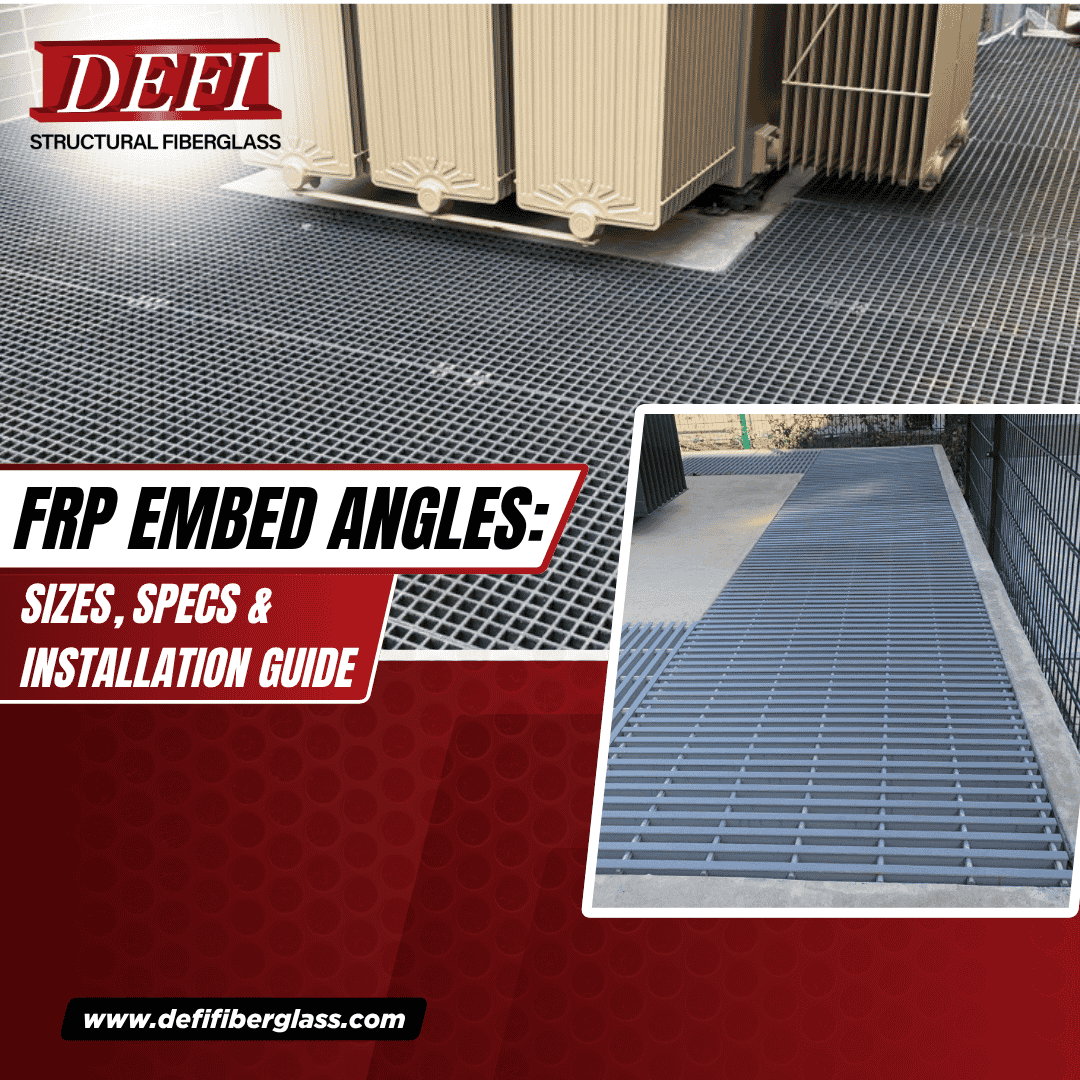
H-beams carry structural loads anywhere corrosion, weight, or conductivity rules out steel, and corrosion resistance is usually the deciding factor in the first place. They’re often paired with fiberglass grating panels to form a complete corrosion-resistant platform. The most common placements:
- Petrochemical and refinery platforms, where H-beams frame walkways and equipment supports in constant chemical exposure. See how DEFI builds for petrochemical operations.
- Tank farms and clarifier structures, where the wide flange gives a stable base for grating and equipment mounts.
- Substations and utility platforms, where non-conductivity is a safety requirement, not a nice-to-have.
- Offshore and wellhead platforms, where lighter structural weight improves buoyancy and cuts crane time during installation.
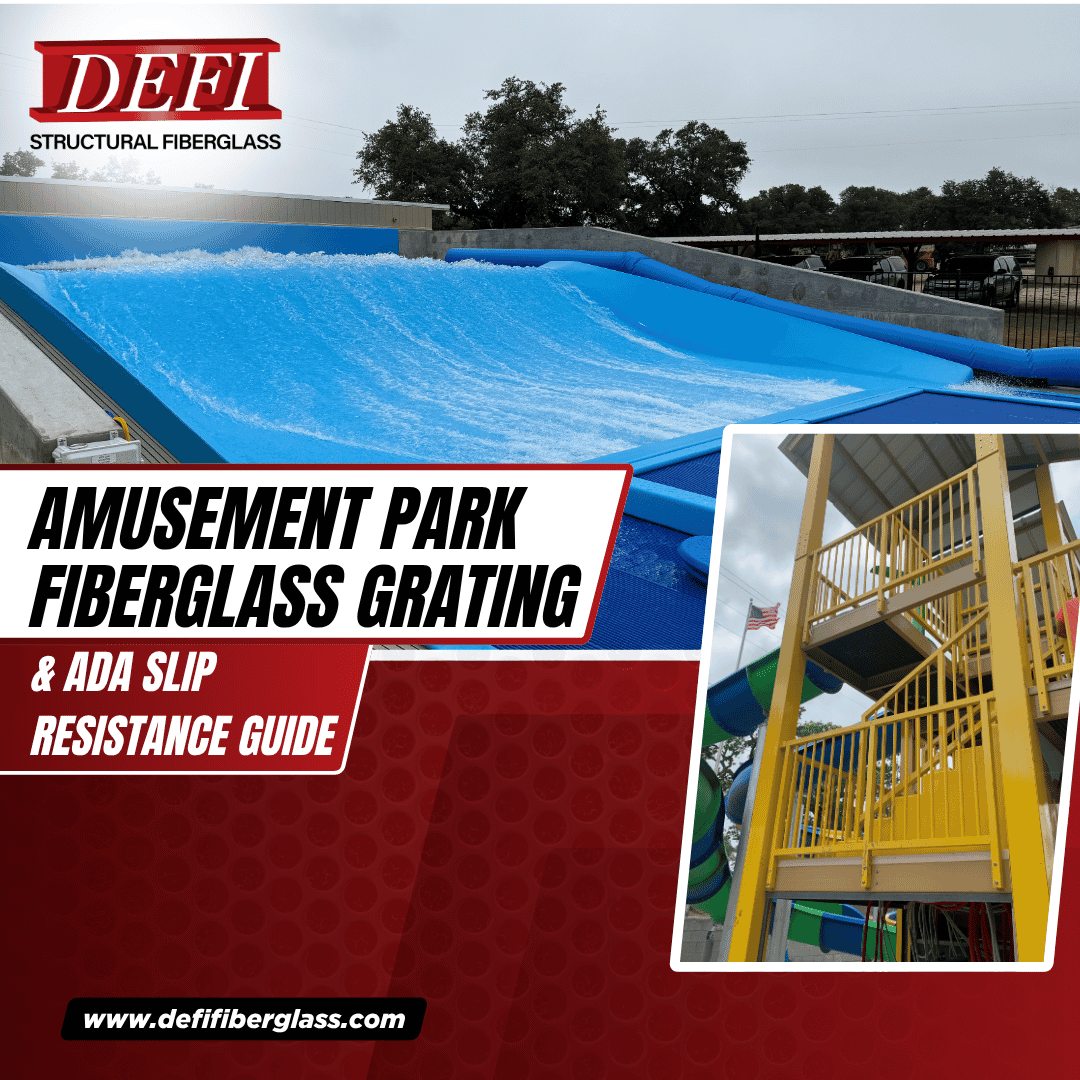
- Waterparks and coastal structures, where constant moisture would corrode an unprotected steel frame within a few seasons.
Buying Pultruded Fiberglass H-Beams in Bulk
DEFI ships H-beams from two Gulf Coast plants, in Houston, Texas and Lafayette, Louisiana, and carries inventory levels built to match a manufacturer’s own stock rather than a typical distributor’s. That matters for bulk orders on a project timeline: standard H-beam sizes ship fast, and the lighter weight means a single truckload carries more linear footage than the same order in steel.
Projects needing non-standard depths, flange widths, or project-specific assemblies go through Louisiana Structural Fiberglass, DEFI’s fabrication division, which handles custom cuts, pipe penetrations, and complete ready-to-install structures rather than just raw stock lengths. That in-house design and fabrication capability is what lets DEFI quote bulk H-beam orders and custom structural applications on the same timeline.
Reduce Risk, Reduce Overhead, and Increase Value With FRP
FRP structural products are becoming the default choice for everything from municipal playground structures to offshore wellhead platforms. At DEFI, specifying our H-beams and other structural profiles gets you a better return on investment because the material is more durable, poses no electrical or corrosion risk, and installs faster than steel. Whether you run a waterpark, a municipal park system, or an offshore rig, the math works the same way: fewer replacements, fewer repairs, lower overall cost across a 20-to-30-year service life.
Contact DEFI today for a quote on standard or bulk pultruded fiberglass H-beam orders.
FAQ
Is a pultruded fiberglass H-beam really as strong as steel?
Pound for pound, yes. Standard fiberglass H-beams test at roughly 30,000 PSI tensile and flexural strength lengthwise, in the same range as structural steel. Because steel has a much higher modulus of elasticity, engineers typically spec a deeper or thicker fiberglass section to match steel’s stiffness rather than substituting an identical size.
How much lighter is an FRP H-beam than a steel one?
About 75-80% lighter for a comparable section. A 10×5-inch fiberglass I-beam runs roughly 11 pounds per foot against 44 pounds per foot for the steel equivalent, which is why fiberglass structures ship on standard freight and install without cranes.
Are fiberglass H-beams actually non-conductive?
Yes. Independent lab testing puts dielectric strength around 200 volts/mil, which is why H-beams are standard for substation platforms, transformer mounting structures, and cable tray supports where a conductive material would create a shock hazard.
Can you order FRP H-beams in bulk?
Yes. DEFI stocks standard sizes from its Houston and Lafayette plants at inventory levels built to match a manufacturer’s own stock, and routes custom sizing or project-specific fabrication through its Louisiana Structural Fiberglass division.
How long do fiberglass H-beams last in corrosive environments?
FRP structural members commonly run 25 to 50 years in wastewater, petrochemical, and marine settings without the repainting or replacement schedule steel requires in the same conditions.
What sizes do pultruded fiberglass H-beams come in?
Standard H-beam depths typically run from 4 to 24 inches with flange widths from 4 to 12 inches, in standard lengths up to 48 feet. Custom depths, flange widths, and lengths are available for project-specific loads.
Where are fiberglass H-beams used most?
Petrochemical and refinery platforms, tank farms, substations and utility structures, offshore and wellhead platforms, and waterpark or coastal structures, anywhere corrosion, weight, or electrical conductivity rules out steel.